#1
Fender Jazz Bass
Jazz bass standard (Jaco Pastorius, Ray Brown-influenced electric) · 2 single-coil Jazz Bass pickups, 34-inch scale, 1.5-inch nut, alder body(Player Jazz: $650–$800 used)Best for: Jazz electric bass standard, bridge and neck pickup combination for jazz bass character, 1.5-inch narrow nut for fast jazz walking bass lines, Jaco Pastorius fretless jazz bass heritage
The Fender Jazz Bass is the electric jazz bass standard — Jaco Pastorius's fretless Jazz Bass work on 'Heavy Weather' and countless jazz fusion recordings defined the electric bass role in jazz. The narrow 1.5-inch nut and two single-coil pickups provide the warm, round low-end with defined note articulation that jazz walking bass requires. The neck and bridge pickup combination produces the characteristic J-bass jazz tone. Used at $650–$800.
What to check used: Jazz bass tone typically uses the neck pickup (or both pickups together) rather than the bright bridge pickup solo — the neck pickup's warmth suits jazz's round, sustaining bass character better than the bright bridge pickup. Practice rolling back the bridge pickup volume for traditional jazz bass tone. Also consider a fretless Jazz Bass for the upright bass-approximating fretless tone central to jazz.
#2
Sire Marcus Miller V7
Active Jazz Bass with passive-bypass for jazz versatility · 2 Sire single-coil pickups, 3-band Sire active EQ with passive bypass, 34-inch scale, ash or alder body$600–$700 new / $400–$550 usedBest for: Jazz bass with active EQ control for venue tone adjustment, passive bypass for traditional clean jazz bass tone, Marcus Miller slap jazz fusion approach, session jazz bass versatility
The Sire Marcus Miller V7 is the practical jazz bass standard — the passive/active switch allows both traditional passive Jazz Bass tone for acoustic jazz contexts and active EQ for modern fusion and studio jazz. Marcus Miller's slap jazz fusion playing and the V7's specific setup represent the contemporary professional jazz bass approach. Used at $400–$550.
What to check used: Marcus Miller's playing style is specifically slap jazz fusion — the V7 reflects his particular jazz bass approach rather than general jazz. For traditional acoustic jazz (walking bass, small ensemble), the passive setting on the V7 or a straightforward passive Fender Jazz Bass is appropriate. The active EQ suits contemporary jazz and studio contexts more than traditional jazz.
#3
Ibanez Artcore ABG10CE
Acoustic bass guitar for acoustic jazz settings · Semi-hollow acoustic bass, mahogany body, 34-inch scale, onboard electronics$350–$450 new / $220–$300 usedBest for: Acoustic jazz duo/trio settings where upright bass volume is impractical, acoustic bass guitar approximation of upright bass tone, small acoustic jazz ensemble accompanying acoustic guitar and winds
The Ibanez ABG10CE provides an acoustic bass option for jazz players in intimate acoustic settings — the acoustic bass guitar produces more acoustic volume than electric bass without amplification, suiting duo and trio acoustic jazz contexts. For jazz players who perform in coffee shop, restaurant, and acoustic venue settings where electric bass amplifier volume is impractical, the acoustic bass guitar bridges electric and upright bass approaches. Used at $220–$300.
What to check used: Acoustic bass guitar volume is less than upright double bass — in ensemble settings with a drummer, an acoustic bass guitar is not loud enough without amplification. The acoustic bass guitar works in quiet duet or solo contexts; electric bass with volume control is practical for most jazz ensemble contexts. The acoustic bass is a secondary instrument for specific acoustic settings rather than a primary jazz bass.
#4
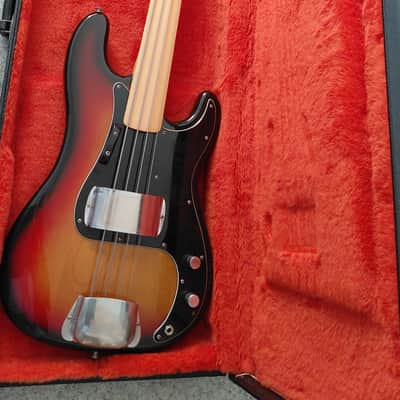
Fender Precision Bass
Jazz P-bass warmth (Paul McCartney, Motown, jazz-rock P-bass) · Split single-coil P-bass pickup, 34-inch scale, 1.75-inch nut, mahogany or alder body(Player P-Bass: $650–$800 used)Best for: Jazz that emphasizes warm, round P-bass tone without J-bass definition, Paul McCartney jazz-rock crossover P-bass tone, smooth fat P-bass low-end for contemporary jazz
The Fender Precision Bass suits jazz players who prefer warmer, rounder bass tone — the P-bass split pickup's midrange emphasis and fat low-end produces a warm, supportive bass quality that works in contemporary jazz contexts. While the Jazz Bass is more associated with traditional jazz, many jazz recordings use P-bass for its round, smooth character. Used at $650–$800.
What to check used: The P-bass's wider 1.75-inch nut (vs J-bass 1.5-inch) changes the playing feel — some jazz bassists find the J-bass's narrower nut width better for fast walking bass lines. Play both before deciding; the tonal difference matters less than the neck feel for regular jazz playing.
#5
Hofner 500/1 Contemporary Series
Vintage jazz-pop violin bass · Fully hollow violin body, 2 Hofner humbucking staple pickups, 30-inch scale, lightweight vintage aesthetics$350–$430 new / $220–$290 usedBest for: Beatles-influenced jazz-pop bass, vintage hollow-body bass for dixieland and swing jazz, very lightweight for long jazz performances, vintage muted jazz bass tone for traditional jazz
The Hofner 500/1 suits traditional jazz and swing that benefits from the muted, warm vintage bass tone — the 30-inch short scale and hollow violin body produce the punchy, muffled character of upright bass in a lighter format. For jazz styles that reference the pre-modern era (swing, bebop, dixieland), the Hofner's vintage tone suits the aesthetic. Paul McCartney's vintage Hofner is the most famous Hofner, but the 500/1 has been used in jazz contexts since the 1960s. Used at $220–$290.
What to check used: The Hofner 500/1's 30-inch short scale produces less bass extension than full-scale instruments — for modern jazz that requires deep, full low-end, a full-scale bass (Jazz Bass, Precision) produces better bass response. The Hofner is appropriate for vintage jazz, rockabilly jazz, and contexts where the muted, vintage character is specifically desired.
#6
Lakland 4402
Professional boutique jazz bass (Chicago-made) · Swamp ash or alder body, Bartolini pickups and preamp, J or P/J configuration, 34-inch scale$1,200–$1,600 usedBest for: Professional jazz and session bass with Bartolini active tone control, boutique Chicago quality for working jazz musicians, P/J or J/J configuration for jazz tonal versatility
The Lakland 4402 is the professional jazz bass standard for working musicians — Bartolini pickups and preamp provide the high-quality active tone control that professional jazz recording and live performance requires. Lakland's Chicago construction standards produce a consistent, reliable instrument. Many professional jazz bassists use Lakland instruments for their refined, studio-quality tone. Used at $1,200–$1,600.
What to check used: Lakland 4402 used market availability is lower than Fender — patience required when seeking the specific configuration. The Lakland Skyline 44-02 (Korean production, $700–$950 used) provides Lakland design with domestic construction at lower cost. Both are quality jazz bass instruments; the Chicago-made 4402 represents the highest Lakland standard.
#7
G&L L-1000
Leo Fender single-humbucker jazz bass · Ash body, single Leo Fender-designed MFD humbucker, 34-inch scale(USA: $900–$1,200 used)Best for: Smooth, warm single-humbucker jazz bass tone, Leo Fender's post-Fender bass design for jazz, American-made G&L quality for jazz bass
The G&L L-1000 is Leo Fender's jazz bass evolution — the single MFD humbucker and aggressive tone controls produce warm, deep, clean jazz bass tone that stands apart from the J-bass and P-bass approach. G&L's American construction quality and Leo Fender's design refinements make the L-1000 a distinctive jazz bass option for players who want something beyond standard Fender designs. Used at $900–$1,200.
What to check used: The G&L L-1000's single humbucker pickup is fundamentally different from J-bass or P-bass configurations — the tone is smooth and powerful but does not replicate either the J-bass or P-bass character. Try the L-1000 before purchasing if you're accustomed to either traditional Fender configuration.
#8
Fender Jazz Bass (Fretless)
Fretless jazz bass (Jaco Pastorius signature tone) · Fretless fingerboard, 2 single-coil Jazz Bass pickups, 34-inch scale, mwah fretless tone(Fender Player Fretless: $700–$850 new / $450–$600 used)Best for: Jaco Pastorius fretless jazz bass tone, upright bass-approximating mwah and glide on fretless fingerboard, jazz fusion and acoustic jazz with fretless expressive quality
The fretless Jazz Bass is the Jaco Pastorius instrument — the fretless fingerboard allows the upright-bass-like sliding, gliding, and pitch expression that defines fretless jazz bass playing. 'Heavy Weather,' 'Teen Town,' and the entirety of Jaco's catalog uses fretless Jazz Bass for its voice-like expressiveness. For jazz players who want the expressive quality of upright bass in an electric instrument, the fretless Jazz Bass is the standard. Used at $450–$600.
What to check used: Fretless bass requires precise left-hand intonation — without frets, the player's ear and finger placement entirely determine pitch accuracy. Fretless bass is significantly more challenging than fretted bass and requires developed pitch awareness before reliable use in jazz ensemble contexts. Practice fretless with a chromatic tuner until intonation is reliable before performing.