Affiliate Disclosure: As an eBay Partner Network Affiliate, we earn from qualifying purchases. Treblemakers may also earn commissions from Reverb and other marketplace links. This doesn't affect the price you pay. Learn more

BEST OVERALL
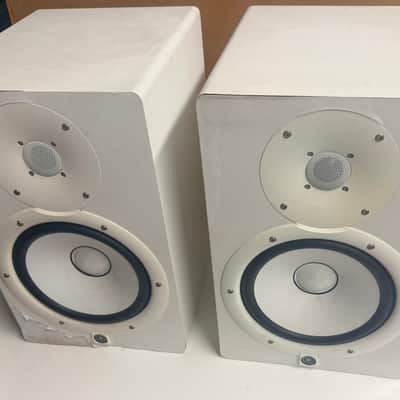
Yamaha HS5
$5 on Reverb
BEST DETAIL
Adam Audio T5V
$200–$320 used
BEST PROFESSIONAL
KRK Rokit 5 G4
$400–$500 used

The Yamaha HS5 is the most recommended studio monitor under $500 — flat response, honest low-mids, and used in commercial studios worldwide. Used pairs go for $250–$370 on Reverb. If you're mixing on consumer speakers, your low-end decisions won't translate to other playback systems.

The used market for studio monitors is excellent: clean, low-use home studio pairs appear regularly at 40–60% off new prices. Every pick here is a substantial upgrade from consumer speakers.

The 7 Best Studio Monitors Under $500

#1

Yamaha HS5

5-inch woofer$250–$370 used (pair)

Best for: Mixing, home studio, nearfield monitoring, reference accuracy

The Yamaha HS5 is the most commonly recommended studio monitor for home recording. The flat response characteristic of the HS series makes mixes translate well to other playback systems. The HS5 is accurate and unforgiving — if your mix sounds good on these, it sounds good everywhere. Used HS5 pairs at $250–$350 are excellent value — these are active (powered) monitors that retail for $400/pair new.

What to check used: The HS5's flat response means it doesn't make music sound exciting — this is intentional. Verify both monitors in the pair power on and produce equal output.

Available now

#2

Adam Audio T5V

5-inch woofer$200–$320 used (pair)

Best for: High-frequency detail, mixing, home studio

Adam Audio's T5V uses a proprietary ribbon tweeter (A-Ribbon) that produces significantly better high-frequency detail than dome tweeters at this price. The air and presence in the high end makes the T5V excellent for mixing drums, cymbals, and vocals. Used T5V pairs at $200–$280 are one of the best values in studio monitors — ribbon tweeter quality at budget pricing.

What to check used: Adam's ribbon tweeter is more fragile than dome tweeters — avoid buying from sellers who can't confirm the tweeter history. Never expose ribbon tweeters to high-frequency clips or very high volume. Verify the tweeter sounds detailed and accurate (not harsh or missing).

#3

KRK Rokit 5 G4

5-inch woofer$220–$320 used (pair)

Best for: Hip-hop, EDM, bass-heavy genres, home production

KRK Rokit monitors have a slight bass boost relative to flat reference monitors — intentionally. This makes them sound exciting and full for tracking and production. The G4 version added built-in DSP EQ and an app for room correction. For hip-hop and EDM producers who want to hear their low end: the Rokit 5 G4 is the standard recommendation. Used pairs at $220–$300 are consistent quality.

What to check used: The KRK Rokit's 'hype' (bass boost + upper-mid presence peak) can make mixes sound better in the room but translate poorly to flat systems. Many producers use Rokits for tracking and a flat reference (Yamaha HS5) for final mixing. Know this before buying.

#4

Focal Alpha 50 Evo

5-inch woofer$400–$500 used (pair)

Best for: Professional reference monitoring, accurate mixing, mastering

Focal makes some of the best studio monitors in the world and the Alpha 50 Evo is their entry-level professional model. Balanced, neutral, wide imaging, and French engineering quality throughout. Used Alpha 50 Evo pairs at $400–$500 represent professional monitoring quality at mid-tier pricing. The best option on this list for producers who want to mix confidently to commercial standards.

What to check used: Verify the pair is genuinely an 'Evo' variant (2020+) vs. the original Alpha 50 — the Evo improved the waveguide and amp section. Focal build quality is excellent; used Focals are reliable.

#5

PreSonus Eris E5 XT

5.25-inch woofer$160–$260 used (pair)

Best for: Home recording, beginners, tracking, home production

PreSonus Eris monitors are the best budget option for entry-level home recording. The E5 XT has acoustic space controls on the back panel (High Cut, Mid Cut, Low Cut) that allow tuning the response to your room — unusual at this price. Used E5 XT pairs at $160–$240 are the entry point for serious home recording. Better than consumer speakers (Logitech, Sonos) in every measurable way for mixing.

What to check used: The acoustic space controls require time to tune correctly for your room. Verify both monitors have the same EQ settings if buying a pair from a single seller.

#6

Yamaha HS7

6.5-inch woofer$350–$480 used (pair)

Best for: Mixing with more low-end information, larger rooms

The Yamaha HS7 is the step up from the HS5 with a 6.5-inch woofer that provides more low-frequency extension (down to ~43Hz vs HS5's 54Hz). For producers who mix bass-heavy music or work in larger rooms, the HS7 gives you more information without adding a subwoofer. Used HS7 pairs at $350–$460 are excellent value for the quality. Same flat, accurate Yamaha response character as the HS5 — just bigger.

What to check used: The HS7 requires more room than the HS5 — in a small bedroom the low-end extension creates more room interaction, not less. Best in a room of at least 10×12 feet. Verify both monitors match in output.

Available now

#7

Genelec 8010A

3-inch woofer$350–$450 used (pair)

Best for: Compact spaces, desktop nearfield, accurate high mids

Genelec is a Finnish professional monitor brand — their 8010A is the smallest model in the 8000 series and provides extraordinary detail in a tiny package. The SAM (Smart Active Monitoring) technology and aluminum die-cast enclosure produce a measured, accurate response. Used 8010A pairs at $350–$450 are boutique quality for mid-tier pricing. A legitimate professional monitoring choice in a small footprint.

What to check used: The 3-inch woofer has limited low-frequency extension (down to ~74Hz) — a subwoofer is needed for accurate bass monitoring. Verify the SAM auto-calibration works correctly.
Used Studio Monitor Inspection Checklist

  • Test each monitor individually: Disconnect one monitor and test the other at moderate volume. Then swap. Each should have equal output, similar tonal character, and no extraneous noise. Matched pairs are essential for accurate stereo imaging.
  • Listen for driver noise: Play a low-frequency sine wave (100Hz, 200Hz — available from free online tone generators) and listen for any rattling, buzzing, or uneven response. Port noise (small popping from the rear port on bass transients) is normal; rattling inside the cabinet is not.
  • Check the tweeter: Play high-frequency content (hi-hats, cymbal tail) and verify the tweeter reproduces high-frequency content clearly without harshness or distortion. Damaged tweeters often sound harsh or produce a tinny rattle on transients.
  • Verify the amp section: Active monitors have built-in amplifiers — turn the volume from minimum to maximum while playing and listen for any distortion, clipping, or dropout below the intended clipping level. The amp should remain clean throughout its range.
  • Test all inputs: Verify both XLR and TRS inputs work correctly (most studio monitors have both). Verify the input level control works smoothly without crackling. Test RCA inputs if present.

Frequently Asked Questions

What are studio monitors and why do I need them for home recording?

Studio monitors are loudspeakers designed for accurate, flat frequency response — they reproduce audio as it is, not as the manufacturer thinks you want it to sound. Consumer speakers (Bose, Sonos, soundbars) add bass boost, presence peaks, and other sound shaping to make music sound pleasing. For home recording and mixing, you need accurate reproduction so your mix decisions translate to other playback systems. A mix that sounds good on Yamaha HS5 monitors will sound good on earbuds, car speakers, and phone speakers.

What size studio monitors do I need?

5-inch woofers (Yamaha HS5, Adam T5V, KRK Rokit 5) are ideal for rooms up to 12×12 feet — the most common home studio size. Larger woofers (6.5 inch, 8 inch) require a larger room to produce accurate low-frequency response — in a small room, bass frequencies pile up and you can't hear what your mix actually sounds like. Start with 5-inch monitors for any home studio. Add a subwoofer if you mix bass-heavy music.

Should I buy used studio monitors?

Yes, with standard used-electronics caution. Studio monitors are passive-use electronics — they're switched on, played at moderate volume for hours, then switched off. Unlike touring gear, home studio monitors typically lead easy lives. Used studio monitors from home studio sellers are usually in excellent condition. Verify: both monitors match in output, no driver noise at any volume, tweeter intact. Buy from Reverb (buyer protection) rather than Craigslist for this category.

What is a good first studio monitor?

The Yamaha HS5 (used pair $250–$350) is the universally recommended first studio monitor. They're accurate, unforgiving, and mixing on them builds good habits — if your mix sounds good on HS5s, it will translate everywhere. The Adam Audio T5V (used pair $200–$280) is a strong alternative with better high-frequency detail from the ribbon tweeter.

Do I need a subwoofer with studio monitors?

For most home recording and mixing: not initially. A pair of Yamaha HS5 monitors supplemented by headphone monitoring during bass-frequency checking is a standard home studio approach. Subwoofers become necessary when: (1) you mix bass-heavy music (hip-hop, EDM), (2) your monitors are small (3 or 4 inch), or (3) your room is large enough that the subwoofer doesn't create standing wave problems. The Yamaha HS8S is a common subwoofer match for HS5/HS7 systems.

Get weekly used gear deals in your inbox

Price drops, new listings, and buyer tips — free, every week.

Unsubscribe any time.

Professional Appraisal

Know what your instrument is worth

Generate an CMA appraisal report in minutes. We pull comparable sold listings from Reverb, eBay, Guitar Center, and more — you select the comps, get statistical analysis, and download a professional PDF. Starting at $8.99.

Studio Monitors — Active Listings

Related Guides

Compare