Reverb
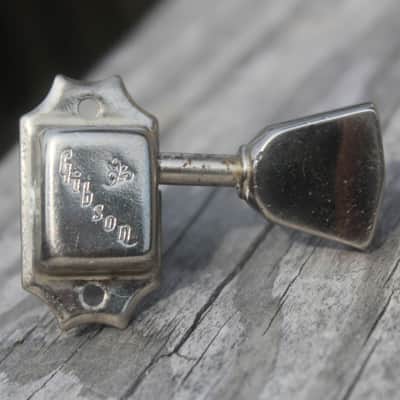
Vintage 1976 Gibson Les Paul Flower Tuner Tulip Bass Side Gibson Logo 1977 1970's Germany Slightly Bent
View on Reverbfair
No Location
Low Price
$25
+ $7 shipping
6d ago
Affiliate Disclosure: As an eBay Partner Network Affiliate, we earn from qualifying purchases. Treblemakers may also earn commissions from Reverb and other marketplace links. This doesn't affect the price you pay. Learn more
Both are Gibsons. Both use the same scale length, same neck joint, and (usually) the same pickups. But they weigh differently, feel differently, and have defined completely different subsets of rock history. Here's the full comparison.
| Gibson Les Paul | Gibson SG | |
|---|---|---|
| Body style | Single cutaway, carved maple top over mahogany | Double cutaway, solid mahogany (no maple cap) |
| Body weight | 9–12 lbs (heavy) | 6–8 lbs (lighter) |
| Neck joint | Set neck, 17° headstock angle | Set neck, angled back ~14° |
| Upper fret access | Restricted (single cutaway body) | Excellent (deep double cutaway) |
| Scale length | 24.75" | 24.75" |
| Tone character | Warmer, thicker — maple cap adds brightness | Slightly thinner, more aggressive midrange |
| Sustain | Very high — dense body and maple cap | Good, but less than Les Paul |
| Best styles | Rock, hard rock, classic rock, jazz-blues | Rock, punk, hard rock, AC/DC, metal |
| Iconic users | Slash, Jimmy Page, Gary Moore | Tony Iommi, Angus Young, Frank Zappa, Pete Townshend |
| Used price (Studio) | $800–$1,200 | $600–$900 |
| Used price (Standard) | $2,000–$3,500 | $1,500–$2,500 |
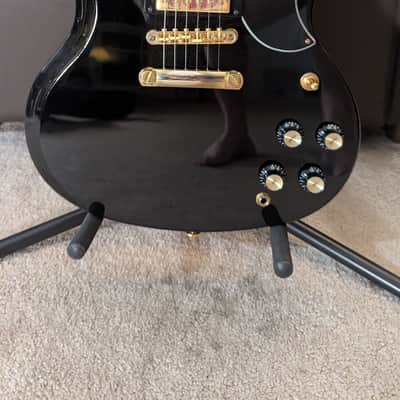
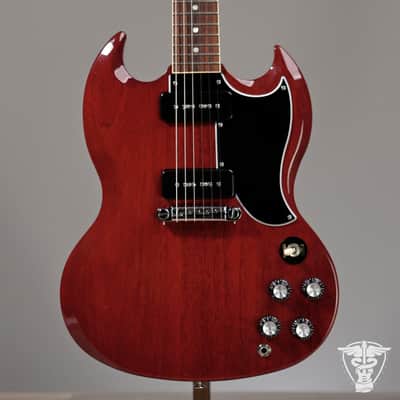
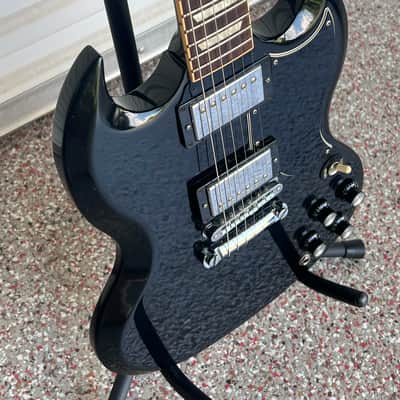
Both use the same scale length (24.75") and typically the same pickups (humbuckers), but the tonal character differs because of the body construction. The Les Paul's carved maple top over mahogany adds brightness and compression — a warm, complex tone that sustains extensively. The SG is solid mahogany with no maple cap: slightly thinner and more aggressive in the midrange. The difference is subtle at clean settings and becomes more pronounced with distortion. Think of it this way: Les Paul = singing, warm lead tone. SG = aggressive, driving rock rhythm tone. Both do both, just with different character.
The SG is the better beginner Gibson for two reasons: (1) It's lighter — SGs run 6–8 lbs vs 9–12 lbs for a Les Paul. The weight difference becomes significant after an hour of playing. (2) It's less expensive — an SG Standard runs $1,500–$2,000 new vs $2,500+ for a Les Paul Standard. Used prices reflect this: SG Studio at $600–$900 used is more accessible than Les Paul Studio at $800–$1,200 used. If you're specifically aiming for Slash tones or blues-rock with heavy sustain: Les Paul. For Angus Young, Tony Iommi, or general rock: SG.
The SG has a deep double cutaway that cuts all the way up the bass and treble sides of the body. This allows your right hand to comfortably reach the 20th, 21st, and 22nd frets without the body getting in the way. The Les Paul's single cutaway only cuts into the treble side of the body, and the joint where the neck meets the body sits around the 16th fret — making upper-fret work (above the 17th) physically uncomfortable for many players. Angus Young's explosive lead playing across the full neck of the SG is only comfortable because the double cutaway makes the upper register accessible.
Both are prone to headstock breaks when dropped — the 14–17° headstock angle that gives Gibsons their sustain and resonance also creates a weak point at the neck/headstock junction. The SG's thinner neck profile and lighter construction may make it slightly more vulnerable. The Les Paul's heavier, thicker neck joint provides more mass at the vulnerable point. In either case: never let a Gibson fall over (invest in a guitar stand), and always use a case when transporting.
Tony Iommi has been synonymous with the Gibson SG since Black Sabbath's earliest recordings. His primary guitars are "Jaydee" custom SGs (built by John Diggins in Birmingham) and various Gibson SG Specials and Customs. Iommi lost the tips of two fingers on his right (fretting) hand in a factory accident in 1965 and restrung his guitar to be played upside-down with very light strings — the SG's lighter weight and deep cutaways made it the most comfortable choice. His down-tuned, low-slung, heavy riffing on the SG defined the sound of heavy metal.