#1
Korg Minilogue
Analog Polyphonic · 4-voice polyphonic$250–$380 usedBest for: First analog synth, learning synthesis, all-around production
The Korg Minilogue is the most recommended beginner synthesizer for good reason — it's a fully analog, 4-voice polyphonic instrument with a clear interface that teaches synthesis concepts visually. Every knob corresponds to a circuit element you can hear respond in real-time. The oscilloscope display shows you the waveform as you shape it. Used at $250–$380, it's one of the best educational tools in electronic music production.
What to check used: Check that all 4 voices produce consistent output — voice imbalance is the most common Minilogue issue. Verify all 37 keys function and the panel controls all move smoothly without crackling.
#2
Arturia MiniBrute 2
Analog Monophonic · Monophonic + patch bay$300–$450 usedBest for: Bass, leads, aggressive tones, learning patching
The Arturia MiniBrute 2 has a full patch bay on the rear panel — you can patch the synth's modules together like a modular synthesizer, making it an excellent teaching tool for understanding signal flow. The Steiner-Parker filter produces a brighter, more aggressive tone than the Moog ladder filter. For beginners interested in modular synthesis or who want to learn patching concepts, the MiniBrute 2 is the best entry point.
What to check used: The patch bay has many points — verify all patch cables make clean connection. Test the keyboard action (some users find MiniBrute 2 keyboard less responsive than dedicated MIDI controllers). Check the Steiner-Parker filter for consistent resonance response.
#3
Roland JU-06A
Digital Analog-Modeling · 4-voice polyphonic$180–$280 usedBest for: 80s pad sounds, retro electronic, atmospheric music
The Roland JU-06A is a faithful digital recreation of the classic Juno-106 — the synthesizer that defined 1980s pop, electronic, and new wave production. Its chorus effect is one of the most musical in synthesizer history. Used Juno-style sounds are found on thousands of classic recordings. The JU-06A is compact and affordable, making it the best entry point to Juno-character sounds without hunting for expensive vintage hardware.
What to check used: The JU-06A uses Roland Boutique format (miniature keys) — verify whether the keyboard action is acceptable to you or if you will use an external MIDI keyboard. Check the USB and audio outputs for clean connection. Digital modeling is excellent but verify the chorus effect works correctly.
#4
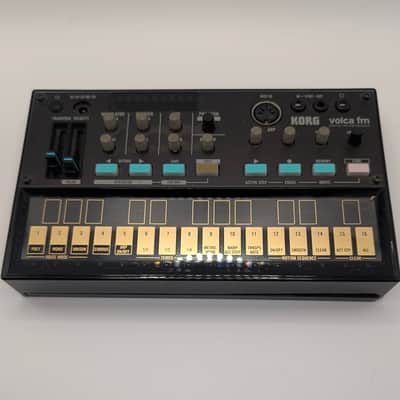
Korg Volca Keys
Analog Polyphonic · 3-voice polyphonic$80–$140 usedBest for: Absolute budget entry, experimental, learning synthesis basics
The Korg Volca Keys is the most affordable analog polyphonic synthesizer available — $80–$140 used, battery powered, and genuinely educational. Three-voice polyphonic with a delay effect, pitch control, and the full complement of synthesis controls in a palm-sized unit. For absolute beginners who want to learn synthesis before investing $300+, the Volca Keys is the best starting point. It's a real synthesizer, not a toy.
What to check used: Check all keys function (very small ribbon-style keys, individual key failures are common). Verify the delay and other effects work. The Volca connects via headphone output — confirm with your monitoring setup.
#5
Moog Mother-32
Semi-Modular Analog · Monophonic + Eurorack$500–$700 usedBest for: Advanced beginners, modular exploration, Moog sound
The Moog Mother-32 is a semi-modular synthesizer that functions as a standalone synth but also connects to Eurorack modular systems. The Moog ladder filter produces the most famous synthesis filter sound in history — warm, musical, with a resonance character that no other filter matches. For beginners who have budget for the next level and want to eventually explore modular synthesis, the Mother-32 is the most educational and future-proof starting point.
What to check used: The Mother-32's 32-step sequencer is part of the appeal — verify the sequencer saves and recalls patterns correctly. Check the patchbay for all connections. Some users experience ground loop noise in certain studio setups — check with your interface.
#6
Arturia MicroBrute
Analog Monophonic · Monophonic$120–$180 usedBest for: Budget analog entry, leads and bass, gritty tones
The Arturia MicroBrute is the most affordable dedicated analog synthesizer with a full keyboard. Oscillator with multiple waveforms, the Steiner-Parker filter, an LFO, and an envelope — everything a beginner needs to learn synthesis fundamentals. No patch bay (that's the MiniBrute 2's territory) but a complete, coherent instrument at $120–$180 used. More comprehensive than the Volcas, less complex than the MiniBrute 2.
What to check used: Check that the Brute Factor knob (feedback control) works correctly — it should add distortion and saturation progressively, not cut output. Verify keyboard action and USB MIDI connectivity.
#7
Behringer Model D
Analog Monophonic · Monophonic$130–$200 usedBest for: Moog Minimoog-style tone at a fraction of the price
The Behringer Model D is a faithful circuit recreation of the Moog Minimoog Model D — one of the most influential synthesizers ever made. It uses the same ladder filter topology and VCO-based oscillators at a fraction of the price. Used Model Ds at $130–$200 give beginners access to genuine Minimoog character without paying $3,000+ for a vintage original. Not Eurorack but has CV inputs for modular connectivity.
What to check used: Early Model D batches had build quality issues (potentiometer noise, calibration drift). Check all controls for clean response. Verify the three oscillators track correctly in pitch across the keyboard range.
#8
Korg Prologue
Analog Polyphonic · 8-voice polyphonic$500–$750 usedBest for: Serious beginner or intermediate, fully-featured analog poly
The Korg Prologue is the professional version of the Minilogue — 8-voice polyphonic, digital FX engine with programmable oscillators (Multi Engine), and lush chorusing. For beginners who can stretch to $500–$750 used, the Prologue is the instrument you will not outgrow. Professional quality, educational interface, and enough capabilities for professional music production. The oscilloscope display carries over from the Minilogue.
What to check used: At 8 voices, verify all 8 produce consistent output — any dead or weak voices should be noted. The Multi Engine programmable oscillator is a complex feature — verify it loads custom oscillators correctly if that matters to you.