Affiliate Disclosure: As an eBay Partner Network Affiliate, we earn from qualifying purchases. Treblemakers may also earn commissions from Reverb and other marketplace links. This doesn't affect the price you pay. Learn more

BEST DIGITAL PIANO
Casio CT-S300 / CT-S400
$250–$450 used
BEST ANALOG SYNTH
Yamaha P-45 / P-125 Digital Piano
$6 on Reverb
BEST VALUE VINTAGE
Roland FP-30X Digital Piano
$19 on Reverb

The most important buying decision is whether you need weighted keys (required for piano technique development) or unweighted keys (fine for synthesis, organ, and production). Nord and Moog instruments hold value best; entry-level digital pianos are safe buys at 50–65% of retail.

All prices below are current used market values (mid-2026). Always verify the power supply is included — proprietary PSUs can be expensive to source.

Unweighted / Semi-weighted Keyboard

Best for: Synthesizers, organ, casual play, production

Lighter action, lower cost. Not suitable for classical piano technique development. Common in Casio arranger keyboards, most synths, and stage organs.

Weighted / Hammer-action Digital Piano

Best for: Classical piano learning, contemporary piano playing

Mimics acoustic piano action. Required for developing proper technique. Yamaha (GH/GHS), Roland (PHA), and Kawai (RHC) are the three main action designs.

Analog Synthesizer

Best for: Electronic music production, textural pads, bass synthesis

True analog circuitry produces warmer, more musical tone than digital emulations. Mono (single note) and poly (chords) options exist. Require more maintenance than digital.

Digital Workstation

Best for: Live performance, composition, standalone production

On-board sequencer, multi-part arrangements, audio recording, and extensive voices. The Korg Kronos, Yamaha Montage, and Roland Fantom are the flagship workstations.

The 8 Best Used Keyboard & Synth Buying Guide

#1

Casio CT-S300 / CT-S400

Entry Keyboard · Budget Starter$40–$70 used

Best for: Budget-constrained beginners or children who need a playable starting point

If budget is the primary concern, a used Casio from the CT-S or CT-X series is a safe starter. 61 mini or full-size keys, basic voices, and a learning mode. Casio build quality is adequate for learning and doesn't deteriorate much with light use.

What to check used: Test every key individually — plastic action keys on budget Casios wear at the hinge points. Stuck or mushy keys are a dealbreaker on cheap keyboards.

#2

Yamaha P-45 / P-125 Digital Piano

Digital Piano · 88 keys · GHS weighted action$250–$450 used

Best for: Beginners and intermediate players who need a reliable weighted digital piano

The Yamaha P-series is the most reliable entry-level digital piano line. The P-45 has 88 weighted keys, Yamaha GHS action, and 10 voices — perfect for beginners. The P-125 adds a better speaker and more voices. Both hold value well and are consistently available used. P-45: $250–$350 used; P-125: $350–$450 used.

What to check used: Test all 88 keys with equal velocity — dead or inconsistent keys are the main failure. Check the sustain pedal input jack.

Available now

#3

Roland FP-30X Digital Piano

Digital Piano · 88 keys · PHA-4 Standard weighted$400–$550 used

Best for: Committed piano players who want Roland's best-in-class action at entry level

Roland's best-in-class action (PHA-4 Standard) at the entry level. The FP-30X sounds and feels significantly better than the equivalent Yamaha P-125. Roland's Bluetooth connectivity and speaker system are also superior. Holds value at 65–75% of retail.

What to check used: Verify the Bluetooth works (requires the Roland Piano app). Check the front panel buttons — they can feel mushy after heavy use.

#4

Nord Electro 6 / Stage 3

Stage Keyboard · Semi-weighted · organ drawbars · professional$1,200–$2,400 used

Best for: Working musicians who need the best live organ, piano, and EP sounds

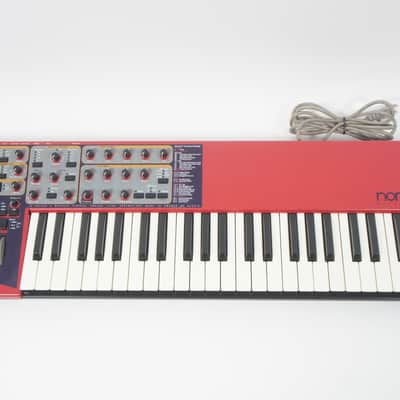
Nord keyboards hold their value better than any other keyboard brand — 75–85% of retail. The Electro 6 is the definitive live keyboard for organ, piano, and EP sounds. The Stage 3 adds synthesis and sample playback. Nord quality is exceptional; these are professional instruments. Electro 6: $1,200–$1,600 used; Stage 3: $1,800–$2,400 used.

What to check used: Check that the Nord OS is current (easily updatable). Test all sounds, the organ drawbars, and live performance mode.

#5

Korg Minilogue

Analog Synthesizer · 4-voice polyphonic · sequencer$300–$400 used

Best for: Players who want polyphonic analog synthesis at an accessible price

The best-value polyphonic analog synth ever made — 4 voices, 37 slim keys, a sequencer, and a built-in oscilloscope. The Minilogue was a landmark product and the used market reflects this: they sell quickly and hold value. The Minilogue XD (hybrid digital/analog) runs $500–$650 used and adds more voices.

What to check used: Test all 4 oscillators together and individually. Polyphonic analog synths can have voices that drop out or detune — cycle through a 4-note chord and listen for inconsistencies.

Available now

#6

Moog Subsequent 25 / Sub Phatty

Analog Synthesizer · Monophonic · Moog filter$400–$900 used

Best for: Players who want authentic Moog filter character — values appreciate over time

Moog synthesizers hold value better than any other keyboard brand — often reselling above original retail after 5+ years. The Sub Phatty is the most affordable Moog with full Moog filter character. Both are mono synths — single note, maximum character. Sub Phatty: $400–$550 used; Subsequent 25: $700–$900 used.

What to check used: Test the filter sweep through its full range — the Moog filter should open and close smoothly with no ticks or crackles. Check the pitch and mod wheels for smooth operation.

Available now

#7

Roland Juno-106

Vintage Synthesizer · 6-voice polyphonic · chorus · 1980s pads$800–$1,400 used

Best for: Players wanting an entry-level vintage polyphonic synth with well-documented repairs

The most reliable and repairable vintage polyphonic synth. 6 voices, chorus, and those distinctive Juno pads that defined 1980s pop music. Common issues (80017A voice chips) are well-documented and repaired cheaply. The Juno-106 is the best vintage synth for first-timers.

What to check used: Dead voices are the primary issue — play every note with chorus off and listen for dead, thin, or detuned voices. The 80017A chip repair is well-known and affordable.

#8

NI Komplete Kontrol S49 / S61

MIDI Controller · Fatar keybed · NI integration · no internal sounds$300–$500 used

Best for: NI software owners who want the best MIDI controller build quality

The best build quality MIDI controller in its price range. Fatar keybed (the best available), deep NI integration, and excellent DAW control. No internal sounds — requires a computer and software. If you already own NI software, the Komplete Kontrol workflow is transformative. S49: $300–$450 used; S61: $350–$500 used.

What to check used: Verify the software is updated and the NI hardware authentication works with your machine. MIDI controllers are mechanically simple — check for stuck keys and verify the pitch/mod wheels work.
Available now

Used Keyboard Inspection Checklist

  • Key test: Power on and play all 88 (or 61/73) keys — listen for dead, stuck, or inconsistent keys. Any key that doesn't respond is a dealbreaker.
  • Velocity response: Test each key at different velocities — weighted action keys should respond consistently from soft to hard playing. Inconsistent velocity response indicates worn contacts.
  • Sustain pedal: Test the sustain pedal jack with a standard sustain pedal. The pedal should activate and release cleanly with no crackling.
  • Speakers & headphones: For digital pianos: test onboard speakers AND headphone output. A failed speaker amp is expensive to repair; verify both outputs work.
  • Voice banks & sequencer: For workstations: test all major voice banks and verify the sequencer works. Corrupted memory banks may indicate battery failure in older units.
  • Oscillator test: For analog synths: test all oscillators individually — listen for detuning or dead voices. Polyphonic synths can lose individual voice chips over time.
  • Pitch wheel: Test pitch wheel — should return exactly to center and stay in tune. A pitch wheel that doesn't center is an intonation nightmare.
  • Mod wheel: Test mod wheel — should move smoothly without crackle or sticking. Crackling pots on mod wheels are cleanable but indicate age.
  • Patch memory: For synths with patch memories: verify a few factory patches load correctly. If factory patches are corrupted, the internal battery may need replacement.
  • Knobs & sliders: Check all physical knobs and sliders for crackle (pot wear) — tolerable but negotiate price. Digital synths with SMD encoders are harder to repair than analog pot-based designs.
  • Screen check: Check the screen (if present) for dead pixels or corruption. Screens on older workstations (Korg Triton, Roland Fantom) can fail and are expensive to replace.
  • Power supply: Verify power supply is included — proprietary power supplies for older synths can be expensive to source or impossible to find. An included PSU is required for purchase.

Frequently Asked Questions

Is it safe to buy a used keyboard or synthesizer?

Yes, with inspection. Digital keyboards (Roland, Yamaha) are extremely reliable — the main failure is worn key action, and keys rarely fail mechanically. Analog synthesizers are more complex but also more repairable — the service documentation and parts for most instruments from the 1980s–2000s are widely available. The biggest risks are: capacitor leakage on vintage synths, worn key contacts on heavily used digital pianos, and missing power supplies.

What used keyboards hold their value best?

Nord keyboards hold value better than any other brand — Nords depreciate to 75–85% of retail and hold there. Moog synthesizers (Sub Phatty, Voyager, Subsequent series) often appreciate over time. Vintage analog synths (Roland Juno-106, Korg DW-8000, Sequential Prophet-6) are appreciating assets. Entry-level digital pianos (Yamaha P-45, Roland FP-30) depreciate to 50–65% of retail.

What is the difference between a keyboard and a synthesizer?

A keyboard is a general term — it refers to any instrument with piano-style keys, including digital pianos, MIDI controllers, organs, and synthesizers. A synthesizer specifically generates sound through electronic circuits (analog) or algorithms (digital) that can be shaped by oscillators, filters, envelopes, and modulation. All synthesizers are keyboards, but not all keyboards are synthesizers.

What action should I look for in a used piano keyboard?

For piano learning, weighted hammer action is essential — Yamaha GH or GHS (Graded Hammer), Roland PHA-4 (Progressive Hammer Action), or Kawai RHC are the main systems. Graded action means the keys feel heavier in the low register (like a real piano) and lighter in the upper register. For synthesis, organ, or production, semi-weighted or unweighted action is fine.

Are vintage analog synthesizers worth buying used?

For experienced players and producers, yes — vintage analog synths have character that digital emulations don't fully replicate, and they appreciate in value. For beginners, the complexity and maintenance requirements make a modern analog (Korg Minilogue, Arturia MiniBrute) a better starting point. Key vintage instruments worth buying used: Roland Juno-106 (well-documented repairs), Korg Polysix (beautiful pads), and the Sequential Prophet-5 for those with the budget.

Get weekly used gear deals in your inbox

Price drops, new listings, and buyer tips — free, every week.

Unsubscribe any time.

Professional Appraisal

Know what your instrument is worth

Generate an CMA appraisal report in minutes. We pull comparable sold listings from Reverb, eBay, Guitar Center, and more — you select the comps, get statistical analysis, and download a professional PDF. Starting at $8.99.

Related Guides