#1
Casio CT-S300
61-key portable keyboard · 61 mini keys, 400 tones, 77 rhythms, 6.5W speaker, battery or AC power$55–$80 usedBest for: Absolute beginners, children, first keyboard, travel practice
The Casio CT-S300 is the most affordable legitimate keyboard for a beginner — 61 mini keys, 400 tones, and 77 rhythm patterns in an extremely lightweight (3.3 lbs) package. Casio's reputation for reliable entry-level keyboards is well-earned; the CT-S300 holds tune, has responsive keys, and runs on batteries for portable use. For a beginner who needs to confirm they want to pursue keyboard before investing more, the CT-S300 is the sensible starting point.
What to check used: Mini keys (61% size of standard piano keys) are not ideal for developing proper piano technique. If the goal is to learn piano seriously, budget up to a model with full-size keys. Verify the battery compartment contacts are not corroded on used units.
#2
Yamaha PSR-E373
61-key portable arranger keyboard · 61 full-size keys, 622 voices, 205 styles, USB-MIDI, 2.5W speakers$130–$180 usedBest for: Beginner to intermediate, learning chord styles, full-size keys for developing technique
The Yamaha PSR-E373 delivers full-size 61 keys — a significant advantage for developing proper piano technique compared to mini-key alternatives. 622 voices and 205 auto-accompaniment styles give it substantial educational content. Yamaha's Education Suite (built-in lessons) and song playback features support structured learning. USB-MIDI connectivity lets you use it with music software on a computer. Used at $130–$180.
What to check used: PSR-E keyboards are not touch-sensitive (velocity-sensitive keys) by default on the E373 — notes play at fixed volume regardless of how hard you press. For developing piano dynamics, step up to the PSR-EW410 or a touch-sensitive digital piano. Verify all key contacts work across the full range.
#3
Roland GO:KEYS 3
61-key portable keyboard with smart features · 61 full-size keys, 500 tones, Bluetooth audio, loop mix function, USB MIDI$150–$220 usedBest for: Modern beginner, songwriting with loops, Bluetooth streaming, creative keyboard learning
The Roland GO:KEYS 3 is designed for the smartphone generation — Bluetooth connectivity streams music from your phone through the built-in speakers, the Loop Mix function auto-generates chord accompaniments for creative jamming, and Roland's 500 tones are high quality. For beginners who want to explore music making creatively rather than following a traditional lesson structure, the GO:KEYS offers a more intuitive on-ramp. Used at $150–$220.
What to check used: The GO:KEYS is not a weighted or semi-weighted keyboard — it uses lightweight unweighted keys. For developing piano touch, a weighted keyboard is necessary. Verify the Bluetooth pairing function works (connect to a phone to test before purchasing used).
#4
Casio PX-S1100
88-key digital piano · 88 weighted keys, Smart Scaled Hammer Action Keyboard, 18 voices, Bluetooth, 3.5W+3.5W stereo$380–$520 usedBest for: Serious piano learners, developing proper touch, home digital piano in portable format
The Casio PX-S1100 is one of the slimmest 88-key weighted keyboards ever made — at 2.3 inches thin, it is genuinely portable despite having full-size weighted keys. The Smart Scaled Hammer Action provides realistic piano touch — keys feel heavier in the bass, lighter in the treble, simulating a real piano mechanism. 88 weighted keys is the minimum required for serious piano development. At $380–$520 used, the PX-S1100 is the most practical weighted piano for players who need portability.
What to check used: The PX-S1100 is slim but still heavy (22 lbs) for a portable instrument. Verify all 88 keys are producing sound and the weighted mechanism feels consistent across the keyboard — any sticky or non-responsive keys indicate key mechanism issues that can require service. The built-in speaker system is 3.5W per side, adequate for quiet practice but not for live performance.
#5
Korg B2
88-key digital piano · 88 weighted keys, RH3 Real Weighted Hammer Action, 12 voices, 15W speakers, slim design$380–$520 usedBest for: 88-key weighted practice piano, beginner to intermediate piano learner, home use
The Korg B2 is a direct competitor to the Casio PX-S1100 in the entry 88-key weighted segment. The RH3 Hammer Action is Korg's standard action — it provides good piano feel at this price point. The B2's 12 voices include high-quality piano samples, and the 15W speaker system is louder than the PX-S1100 for room-filling sound. For piano learners who want 88 weighted keys at a practical budget, Korg B2 and Casio PX-S1100 are the two dominant options.
What to check used: Compared to the PX-S1100, the B2 is slightly thicker but uses the same class of action. Verify the RH3 action feels even across the keyboard. Korg B2 power supply is a specific unit — verify it is included.
#6
Roland FP-30X
88-key digital piano · 88 weighted keys, PHA-4 Standard Keyboard, SuperNATURAL piano sound, Bluetooth, 22W stereo$480–$650 usedBest for: Serious piano development, professional piano sounds, Roland quality in portable format
The Roland FP-30X is widely considered the best 88-key portable digital piano under $1,000 — the PHA-4 Standard Keyboard provides escape action (the keys rebound from the bottom with a slight trigger, like a real grand piano action), and Roland's SuperNATURAL piano engine produces the most realistic piano sound at this price point. It's significantly better in touch and sound than the Casio PX-S1100 and Korg B2 for professional development. Used at $480–$650.
What to check used: The FP-30X is heavier than the PX-S1100 (31 lbs vs 22 lbs) — portability is relative. The escape action is a premium feature that purists appreciate; beginners may not notice the difference immediately but it matters for developing advanced piano technique. Verify Bluetooth audio works for streaming.
#7
Yamaha MODX6
61-key semi-weighted synthesizer/workstation · 61 semi-weighted keys, FSX action, FM-X + AWM2 engines, Motif sample library, USB$700–$950 usedBest for: Professional stage keyboard, synth production, FM synthesis exploration, gigging keyboardist
The Yamaha MODX6 is a professional performance keyboard — not a piano learner instrument but a gigging synthesizer with Yamaha's Motif sound library (one of the most respected sample libraries in professional keyboard use), FM-X synthesis engine, and full MIDI/USB integration. For keyboardists who play in bands and need studio-quality stage sounds in a portable 61-key format, the MODX6 delivers professional results at a used price well below new. Used at $700–$950.
What to check used: The MODX6 is a professional workstation, not a beginner keyboard — the deep voice editing and synthesis features take time to learn. FSX action is semi-weighted (not fully weighted) — it has more resistance than unweighted keys but less than a true piano action. Verify the HDMI output and USB audio interface functions are working.
#8
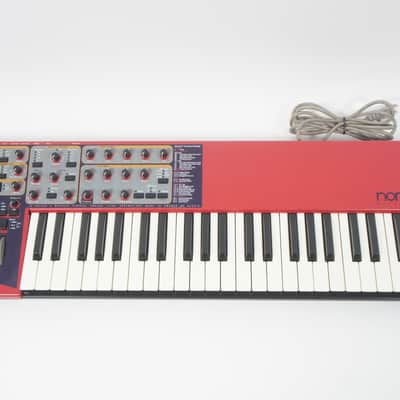
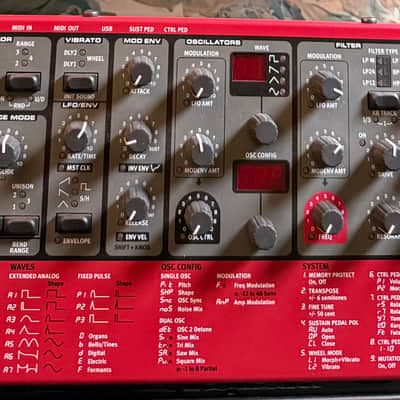
Nord Piano 4
73-key stage piano · 73 weighted keys, Virtual Hammer Action, Nord Piano library, Piano section + Synth section$1,400–$1,900 usedBest for: Professional stage pianist, Nord aesthetic and sound quality, recording and live stage
The Nord Piano 4 is the professional gigging pianist's keyboard — the red aluminum chassis is instantly recognizable on stages worldwide, the Virtual Hammer Action provides credible piano touch for live performance, and the Nord Piano library of meticulously sampled acoustic and electric pianos is industry-respected. The combined Piano + Synth layers allow layering piano sounds with synthesizer for rich performance textures. Used at $1,400–$1,900.
What to check used: Nord keyboards use proprietary Nord Piano library sounds loaded from USB — verify the current library is fully loaded and not partially corrupted. The Virtual Hammer Action is excellent for a stage piano but is not equivalent to a high-end digital piano action. Check for any key noise or uneven response across the 73-key range.