#1
Fender Rumble 25
Best budget bass amp (beginner standard) · 25W, 8-inch speaker, 3-band EQ, contour switch, headphone output, aux input, overdrive circuit$110–$140 new / $70–$100 usedBest for: Beginner bass players who want a reliable, straightforward practice amp with Fender quality and the standard feature set for under $200
The Fender Rumble 25 is the standard recommendation for beginner bass amplification — 25W provides enough volume for bedroom practice with headroom to spare, the 3-band EQ covers all necessary tonal adjustment, and the built-in overdrive circuit is included without additional cost. The contour switch provides automatic mid-scoop for modern bass tone. Headphone output enables silent practice. Fender's Rumble line is the most commonly stocked bass amp line at music retailers, meaning parts and support are readily available. Used at $70–$100.
What to check used: The Fender Rumble 25's 8-inch speaker produces limited low-end at higher volumes — at low bedroom practice volumes, the bass response is adequate, but at rehearsal volumes the 8-inch speaker cannot move the air a 10-inch or 12-inch speaker can. For players who eventually want to play with other musicians, the Fender Rumble 40 (10-inch speaker, $150–$180 used) is worth the additional cost.
#2
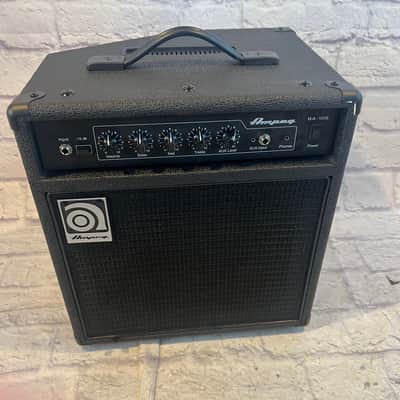
Ampeg BA-108v2
Ampeg entry-level (classic bass amp brand) · 20W, 8-inch speaker, Ampeg Style Switch (bass-boosted preamp character), headphone/aux I/O$90–$120 new / $60–$85 usedBest for: Players who want Ampeg brand character at budget pricing, the Ampeg tonal signature for classic rock and R&B bass at the lowest price point
The Ampeg BA-108v2 is the lowest-cost entry into Ampeg's bass amplification character — the Ampeg Style Switch engages the Ampeg preamp voicing that produces the brand's classic warm, mid-forward tone. For players whose musical heroes used Ampeg SVT amplifiers (John Entwistle, James Jamerson, Geddy Lee on early Rush), the BA-108v2 provides Ampeg character at the $60–$85 used price point. Ampeg quality is reliable at all price tiers.
What to check used: The Ampeg BA-108v2 at 20W is slightly less powerful than the Fender Rumble 25 — for the same price, the Rumble 25 provides 5 more watts and more comprehensive EQ. The Ampeg advantage is brand character, not power or features. Choose the BA-108v2 specifically for the Ampeg voicing; choose the Rumble 25 for better feature-to-price ratio.
#3
Orange Crush Bass 25
British character bass practice amp · 25W, 8-inch speaker, Orange 2-band active EQ, headphone output with CabSim, tuner output$130–$160 new / $85–$115 usedBest for: Players who want British bass amp character (warm, present mids), Orange aesthetic, headphone CabSim for silent practice with realistic cab simulation
The Orange Crush Bass 25 provides British bass amp voicing at practice amp pricing — the Orange 2-band active EQ produces warm midrange character distinct from the American Fender Rumble voicing. The headphone CabSim output simulates cabinet response for realistic silent practice sound, a feature uncommon in this price range. Used at $85–$115.
What to check used: The Orange Crush Bass 25's 2-band EQ (bass and treble only, no midrange control) is less flexible than the 3-band EQ on the Fender Rumble 25. For players who need detailed midrange shaping, the Rumble's 3-band EQ is more useful. The Orange is the choice for players who prefer British amp warmth over EQ flexibility.
#4
Hartke HD15
Budget aluminum cone bass amp · 15W, 5-inch aluminum cone speaker, 2-band EQ, headphone output$80–$100 new / $50–$70 usedBest for: Absolute minimum-cost entry for bass practice, apartment-volume practice, Hartke aluminum cone character at minimum price
The Hartke HD15 is the most affordable practice bass amp from an established bass amp manufacturer — 15W is sufficient for personal bedroom practice at conversational volumes, and the Hartke aluminum cone speaker produces a bright, defined attack character different from paper cone alternatives. Used at $50–$70, the HD15 is the minimum viable bass practice option.
What to check used: The Hartke HD15's 5-inch speaker is the smallest speaker in any recommended bass amp — low frequencies require speaker cone displacement, and a 5-inch speaker cannot produce meaningful low-end at higher volumes. The HD15 is apartment-volume only; for players who want to play at comfortable practice room volumes, the Fender Rumble 25 or 40 is more appropriate.
#5
Blackstar Unity Bass 30
Studio-quality headphone practice (USB recording) · 30W, 8-inch speaker, 3-band EQ, USB recording interface, headphone out with cab simulation, 4 character voices$160–$200 new / $100–$140 usedBest for: Home recording bassists who want USB direct recording capability, 4 amp character voices for tonal range, professional headphone cabinet simulation for silent practice
The Blackstar Unity Bass 30 is the best recording-focused bass practice amp under $200 — the USB recording interface enables direct-to-DAW recording without a separate audio interface, and the 4-voice preamp character selection (Clean, Rock, Blues, Metal) covers the primary bass tone categories. The cabinet-simulated headphone output produces realistic bass amp tone for silent recording. Used at $100–$140.
What to check used: The Blackstar Unity Bass 30 at $160–$200 new is at the top of the $200 budget — for players who do not need USB recording, the Fender Rumble 25 at $70–$100 used provides similar practice functionality at lower cost. The Unity Bass 30 is the specific choice for players who need USB recording as a primary feature.
#6
Phil Jones Bass BG-75
Premium mini bass amp (studio quality) · 75W, 2×4-inch speakers, 3-band EQ, line output, aux input, headphone output, compact form factor$150–$200 new / $100–$150 usedBest for: Players who want the highest quality small bass amp for studio monitoring and practice, professional sound engineers and studio musicians who need a monitoring-quality small bass amp
The Phil Jones Bass BG-75 is the highest-fidelity small bass amp in the under-$200 category — PJB's dual 4-inch speaker configuration produces flat, accurate frequency response appropriate for recording monitoring, and the 75W power rating provides surprising volume from a compact form. The BG-75 is the choice for players who prioritize sound accuracy over volume or size. Used at $100–$150.
What to check used: Phil Jones Bass amps are professional instruments priced above consumer alternatives — the BG-75 is the budget end of the PJB product range. Players who do not need professional monitoring accuracy will be equally well-served by the Fender Rumble 25 at lower cost. The PJB is the recommendation specifically for studio and monitoring applications.
#7
Peavey Max 110
10-inch speaker bass practice amp · 35W, 10-inch speaker, 3-band EQ with Mid-Contour switch, headphone output, aux input$130–$160 new / $80–$110 usedBest for: Players who want a 10-inch speaker for better low-end at practice volumes, Peavey American reliability at budget pricing
The Peavey Max 110 is the best under-$200 bass amp with a 10-inch speaker — the larger speaker produces significantly better low-frequency response than 8-inch speaker alternatives at identical volume levels. 35W provides practice-to-small-rehearsal headroom. The Mid-Contour switch provides automatic mid-scoop for modern bass scooped tone. Peavey durability is well-established — Peavey amps from the 1980s–2000s remain functional today. Used at $80–$110.
What to check used: Peavey ceased operations in 2020 and repair support is now limited to third-party technicians — for players who prioritize manufacturer support and warranty, Fender or Ampeg are more appropriate. Used Peavey Max amps are excellent value but purchasing new is no longer possible, and warranty service is unavailable.