#1
Martin 000-15M
OM/000 body all-mahogany · Solid mahogany top, back, and sides, 000 body (14-fret), satin finish, high-altitude mahogany, vintage styling$700–$800 new / $500–$650 usedBest for: Best small-body Martin, all-mahogany warm tone, fingerpicking and blues, intimate playing character
The Martin 000-15M is the most recommended small-body acoustic guitar — an all-solid-mahogany instrument with a 000 body that produces a warm, focused, fundamentally rich tone different from bright spruce-top Martins. The satin finish and lack of binding give it a working guitar simplicity. The 000 body (smaller than the 000-28, same as the OM body size) is comfortable for smaller players and fingerstyle players who find dreadnoughts oversized. Used at $500–$650.
What to check used: All-mahogany guitars are warmer and darker than spruce-top equivalents — the 000-15M lacks the bright, open projection of a D-28 or OM-28. This is a feature for fingerpickers and blues players who want warmth; it is a limitation for flatpickers who need more cutting treble presence.
#2
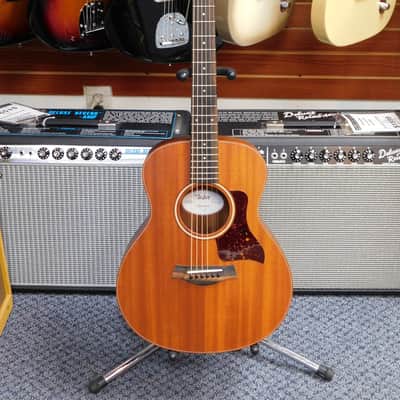
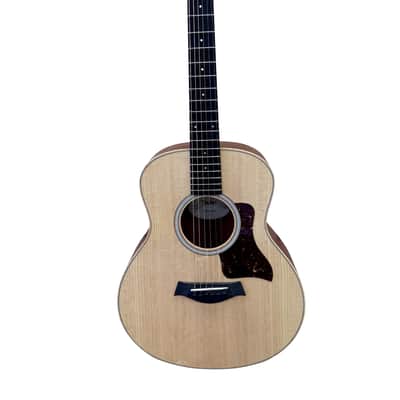
Taylor GS Mini
Travel/small body acoustic · Small GS Mini body, layered sapele back/sides, solid Sitka spruce top, 23.5-inch scale length, travel size$450–$500 new / $320–$400 usedBest for: Travel and small space, Taylor neck feel in compact size, layered sides durability, family-friendly
The Taylor GS Mini is the most popular small acoustic guitar — Taylor's compact body design with a solid spruce top and 23.5-inch scale length produces a genuine acoustic experience in a significantly smaller instrument. The shorter scale length is friendlier for smaller hands and lighter tension. The GS Mini's tone is surprisingly full for its size due to the body design. Used at $320–$400.
What to check used: The GS Mini's shorter scale length produces lighter string tension — the feel is different from a full-scale acoustic, which some players notice. The layered (laminate) back and sides are a cost and durability compromise — they withstand humidity changes better than solid wood but produce different resonance. Players who want full solid-wood construction should look at the Martin 000-15M.
#3
Fender CP-60S Parlor
Traditional parlor body · Solid spruce top, mahogany back/sides, parlor body, 25.3-inch scale, vintage styling$230–$260 new / $160–$200 usedBest for: Budget parlor guitar with solid spruce top, vintage aesthetic, traditional small-body feel
The Fender CP-60S is the most affordable parlor guitar with a solid spruce top — at $160–$200 used, it provides genuine parlor guitar character (small body, close playing experience, present tone) with a solid top that will open up tonally over time. The vintage styling suits the parlor form. For players who want a traditional parlor guitar without a significant investment, the CP-60S is the practical entry point.
What to check used: The CP-60S's solid spruce top is its main advantage at the price point — the back and sides are laminate mahogany, which is standard at this price. The guitar plays and sounds better than fully laminate alternatives, but the solid top benefits are limited when paired with laminate back and sides. A step up to the Martin 000-15M provides all-solid construction.
#4
Recording King RPH-05
Traditional parlor guitar (all-solid) · Solid spruce top, solid mahogany back/sides, standard-scale parlor body, gloss finish$280–$350 new / $200–$270 usedBest for: All-solid parlor at mid-range price, Recording King quality, traditional parlor character
The Recording King RPH-05 is the all-solid-wood parlor guitar in the mid-range price tier — solid spruce top and solid mahogany back and sides at $200–$270 used provides full solid-wood resonance that benefits from age and playing. Recording King specifically focuses on vintage-inspired acoustic instruments and the RPH-05's construction is appropriate for the parlor format. For players who want all-solid construction without Martin prices, the RPH-05 is the strong mid-range option.
What to check used: All-solid wood construction requires humidity management — keep the guitar at 45-55% relative humidity to prevent drying and cracking. Parlor guitar bodies are smaller, which can make humidity-related issues less severe than on large-body instruments, but solid tops still require attention in dry climates.
#5
Eastman E10P
Traditional parlor (handbuilt quality) · Solid Adirondack spruce top, solid mahogany back/sides, handbuilt Eastman construction, ebony bridge$800–$1,000 new / $600–$800 usedBest for: Premium parlor guitar quality, Adirondack spruce brightness, handbuilt Eastman construction
The Eastman E10P is the premium all-solid parlor guitar — hand-graduated solid Adirondack (red spruce) top with solid mahogany back and sides provides exceptional acoustic resonance and the bright, focused projection of a quality parlor guitar. Eastman's hand-graduated construction improves acoustic projection over pressed or machine-graduated tops. For players who want the best acoustic quality in a small-body instrument, the E10P is the reference. Used at $600–$800.
What to check used: Adirondack spruce is a premium top wood — more stiff and bright than Sitka spruce, often used on pre-war and vintage-style instruments. The brightness of an Adirondack top in a small parlor body produces a punchy, present tone that is distinct from warm mahogany-top alternatives. This character suits fingerpickers and Piedmont-style blues players specifically.
#6
Martin 00-15M
Extra-small body (smaller than 000) · Solid mahogany top, back, sides, 00 body (slightly smaller than 000), satin finish, parlor-size$550–$650 new / $400–$520 usedBest for: Even smaller body than 000-15M, true parlor scale, intimate playing, women's guitar, smaller players
The Martin 00-15M is the smaller sibling of the 000-15M — the 00 body (also called the Concert body) is slightly smaller than the 000 Orchestra body, and the resulting guitar is more intimate and personal in its sound projection. For players who find the 000 body still slightly large (particularly smaller-framed players), the 00-15M is the step down to a genuinely small acoustic. The all-solid mahogany construction maintains the warm character of the Martin 15 series. Used at $400–$520.
What to check used: The 00-15M is genuinely small — the reduced body size produces less bass response and lower volume than the 000-15M. Players who want their small acoustic to fill a room should consider the 000-15M or a 000 with a spruce top. The 00-15M is intimate and personal by design.
#7
Waterloo WL-14
Vintage-style OOO/parlor guitar (Collings-built) · Vintage-construction OOO body, built by Collings Guitars, period-correct appointments, hide glue construction$1,800–$2,200 new / $1,400–$1,800 usedBest for: Premium vintage-voiced parlor/OOO, built by Collings, pre-war sound with modern reliability
The Waterloo WL-14 is designed and built by Collings Guitars — one of the most respected American acoustic guitar builders in Austin, Texas. Waterloo is Collings's vintage-voiced line, designed to produce the tonality of pre-war small-body acoustics with modern manufacturing reliability (bone nut, hide glue construction). The WL-14 is the access point to pre-war acoustic tone without the investment risk of a vintage instrument. Used at $1,400–$1,800.
What to check used: The Waterloo WL-14 is a significant investment appropriate for players who are committed to small-body acoustic playing at a professional level. The pre-war construction and tone character are specific — it is not a general-purpose acoustic guitar.
#8
Yamaha APXT2 (Reduced Scale)
Reduced-size acoustic-electric · 3/4 size, spruce top, rosewood fretboard, System 68 pickup, built-in tuner, travel-friendly$150–$200 new / $100–$140 usedBest for: Budget travel acoustic-electric, beginners and children, electronics included at budget price
The Yamaha APXT2 is the 3/4-size acoustic-electric for the budget player who needs a small instrument — electronics, tuner, and decent acoustic tone at $100–$140 used. For younger players, smaller adults, or players who specifically need an acoustic with electronics in a compact format, the APXT2 is the practical choice. Yamaha's quality control at this price is better than many competing budget small acoustics.
What to check used: The APXT2's 3/4 size is noticeably smaller than even a parlor guitar — the short scale and narrow body limit the acoustic projection significantly. It is appropriate as a practice instrument or travel guitar but is not a performing acoustic. Players who want serious acoustic tone in a small package should invest in the Martin 000-15M or Recording King RPH-05.