#1
Boss TU-3 Chromatic Tuner Pedal
Pedal tuner (most important first pedal) · Chromatic tuner, mutes signal while tuning, powers other pedals via boss daisy-chain, buffered bypass$60–$80 new / $40–$60 usedBest for: First pedal for any guitarist, signal mute for silent tuning during performance, powers other pedals
The Boss TU-3 is the recommended first guitar pedal — not because it changes your tone, but because tuning is the most basic performance requirement. The TU-3 sits at the beginning of the signal chain, allows silent tuning (mutes the signal while you tune), and can power other pedals from its 9V output. On a stage, tuning between songs without the audience hearing you tune is essential. The TU-3 has been the standard professional floor tuner for decades and is virtually indestructible.
What to check used: Buying a tuner pedal before getting a pedal board and power supply can mean you end up with a floor tuner that requires its own battery or adapter. The TU-3's ability to power other pedals via the output jack (daisy-chain) is useful but limited — it can power a few small pedals but not a full board. Budget for a dedicated power supply (Voodoo Lab Pedal Power, One Spot) as the pedal collection grows.
#2
Boss DS-1 Distortion
Classic distortion pedal · Distortion circuit, tone and level controls, Boss legendary build quality, used on countless recordings$45–$55 new / $30–$45 usedBest for: First distortion pedal, classic rock tone, indestructible Boss construction, affordable entry into distortion
The Boss DS-1 is the most popular guitar pedal in history — the orange box was used by Kurt Cobain, Steve Vai, Joe Satriani, and countless other players. The DS-1 provides simple, versatile distortion with a single Tone control that goes from dark and smooth to bright and harsh. At $30–$45 used, it is the practical first distortion pedal. The Boss build quality means it will outlast most guitars. After 40 years of production, the DS-1 remains the reference for accessible distortion.
What to check used: The DS-1 is bright-voiced — at higher Tone settings, the distortion can sound harsh and thin through some amp/guitar combinations. Many players run the Tone control at 9-11 o'clock rather than at 12 or above for a more musical character. Also, the DS-1 does not clean up well when the guitar volume is rolled back — it retains the distortion character. The Ibanez TS9 (overdrive rather than distortion) responds more dynamically to guitar volume.
#3
Ibanez TS9 Tube Screamer
Classic overdrive pedal · Soft-clipping overdrive, mid-boost character, drive/tone/level controls, JRC4558 chip, standard overdrive reference$90–$110 new / $65–$85 usedBest for: Most famous overdrive pedal, boost for tube amps, blues and rock lead tone, dynamic response to picking
The Ibanez TS9 Tube Screamer is the definitive overdrive pedal — the green box used by Stevie Ray Vaughan, John Mayer, Gary Moore, and many others. The Tube Screamer's mid-boost characteristic adds warmth and sustain to lead tones and boosts tube amps into harmonically rich saturation. Unlike the DS-1 (high gain distortion), the TS9 is a low-to-medium gain overdrive that responds to the guitar's volume knob — roll back the guitar volume for clean, open it for overdrive. Used at $65–$85.
What to check used: The Tube Screamer's mid-boost is a specific tonal color — it makes everything warmer and thicker, which is excellent through most tube amps but can make solid-state amps sound muddy. The TS9 into a clean tube amp at edge-of-breakup (volume at 6-7) is the classic combination; the TS9 into a high-gain amp adds more distortion rather than the warm-boost character. Learn the pedal-amp interaction for the TS9's characteristic sound.
#4
Boss RC-1 Loop Station
Looper pedal (for solo practice) · 12 minutes of recording, stereo in/out, tap tempo, simple one-button operation, LED ring indicator$70–$90 new / $50–$70 usedBest for: Practice tool for solo improvement, rhythm guitar under lead lines, song writing tool, simplest quality looper
The Boss RC-1 is the most recommended practice looper — recording a chord progression loop and improvising lead lines over it is one of the most effective practice methods for developing soloing technique. The RC-1 is intentionally simple (one footswitch, LED ring indicator) compared to more complex loopers, making it the correct starting point for beginners who want looping without a learning curve. Used at $50–$70.
What to check used: The RC-1 does not include built-in rhythms or click tracks — it records whatever you play and loops it. For players who want a built-in drum machine or tempo reference alongside the looper, the Boss RC-5 or Ditto X2 are more appropriate (at higher prices). The RC-1 is the right pedal for players who specifically want simple loop recording.
#5
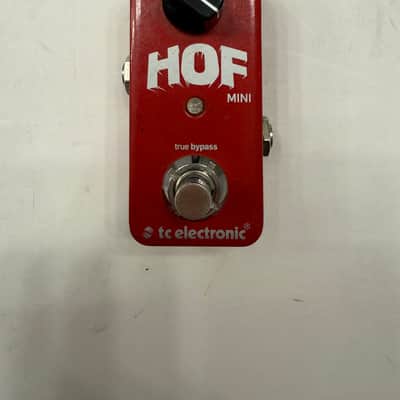
TC Electronic Hall of Fame 2 Reverb
Reverb pedal · Multiple reverb algorithms, TonePrint editor for custom sounds, MASH footswitch, stereo I/O, shimmer reverb$120–$140 new / $80–$110 usedBest for: Best budget reverb pedal, TonePrint customization, shimmer and hall reverbs, stereo use
The TC Electronic Hall of Fame 2 is the recommended starting reverb pedal — reverb is the most common effect guitarists add first, and the Hall of Fame 2 provides a range of high-quality algorithms (Hall, Room, Spring, Shimmer, TonePrint). The TonePrint editor allows loading custom reverb settings from TC's library or creating your own. At $80–$110 used, it is the most features-per-dollar reverb in its tier.
What to check used: The Hall of Fame 2 at $80–$110 used is a premium purchase for a beginner — many budget reverb pedals at $40-50 provide adequate reverb for practice. The Hall of Fame 2's quality is significantly better for performance and recording. Evaluate whether reverb quality is a priority or whether a cheaper option is adequate for your current needs.
#6
MXR M169 Carbon Copy Analog Delay
Analog delay pedal · Analog delay (BBD circuit), up to 600ms delay, warm repeats, modulation control, simple controls$120–$140 new / $85–$115 usedBest for: Warm analog delay tone, simple controls, warm vintage character, first delay for classic rock and country
The MXR Carbon Copy is the most recommended first analog delay pedal — the BBD (bucket-brigade) delay circuit produces warm, slightly degrading repeats that are the classic vintage delay sound (different from the clean digital repeats of digital delays). Simple controls (Delay, Mix, Regen) make it easy to use immediately. The hidden modulation control adds subtle chorus-like pitch modulation to the repeats for a vintage tape echo character. Used at $85–$115.
What to check used: Analog delay pedals like the Carbon Copy have a maximum delay time of 600ms — shorter than digital delays which often offer 1-2 seconds. For longer echoes and complex rhythmic delays, a digital delay (Boss DD-8, TC Flashback) provides more range. The Carbon Copy is specifically for players who want the warm vintage analog delay character rather than maximum flexibility.
#7
Electro-Harmonix Small Clone Chorus
Analog chorus pedal · Analog BBD chorus, simple controls (rate, depth), one or two-button operation, EHX warm chorus character$70–$90 new / $50–$70 usedBest for: Classic chorus tone (Nirvana's Kurt Cobain used this exact pedal), simple analog warmth, budget chorus entry
The Electro-Harmonix Small Clone is the classic chorus pedal — Kurt Cobain used it on the majority of Nirvana recordings. The BBD analog circuit produces a warm, slightly lush chorus that is distinct from modern digital chorus effects. The Small Clone has only two knobs (Rate and Depth) plus a depth switch, making it simple to operate. For players who want classic analog chorus at budget prices, the Small Clone is the most direct path. Used at $50–$70.
What to check used: The Small Clone's 9V power draw is higher than some other EHX pedals — verify your power supply can handle it. The analog chorus character (warm, slightly wobbly) is different from modern digital chorus (more precise, cleaner). Players who want a cleaner, more modern chorus sound should look at the MXR M234 Analog Chorus or TC Electronic Corona.
#8
One Spot CS6 Power Supply
Pedal power supply (not a pedal, but essential) · 6 outputs, 9V 100mA per output, one adapter for multiple pedals, daisy-chain alternative$50–$60 new / $35–$50 usedBest for: Power supply for a growing pedal collection, eliminates individual adapter clutter, essential infrastructure
The One Spot CS6 is listed because power supply is often overlooked in beginner pedal planning — running multiple pedals from individual adapters or batteries is impractical and expensive over time. The CS6 provides 6 isolated 9V outputs from one power source. For players who own 3 or more pedals, a power supply is more cost-effective than individual adapters and reduces noise (isolated outputs prevent ground loops between pedals). Used at $35–$50.
What to check used: The One Spot CS6 provides 100mA per output — enough for most standard analog pedals but insufficient for some digital pedals that require 300mA or more (Boss DD-8, Line 6 HX Stomp). Check the current draw of any digital pedal before connecting to a 100mA output. For high-current pedals, the Voodoo Lab Pedal Power 2+ provides higher-capacity outputs.