#1
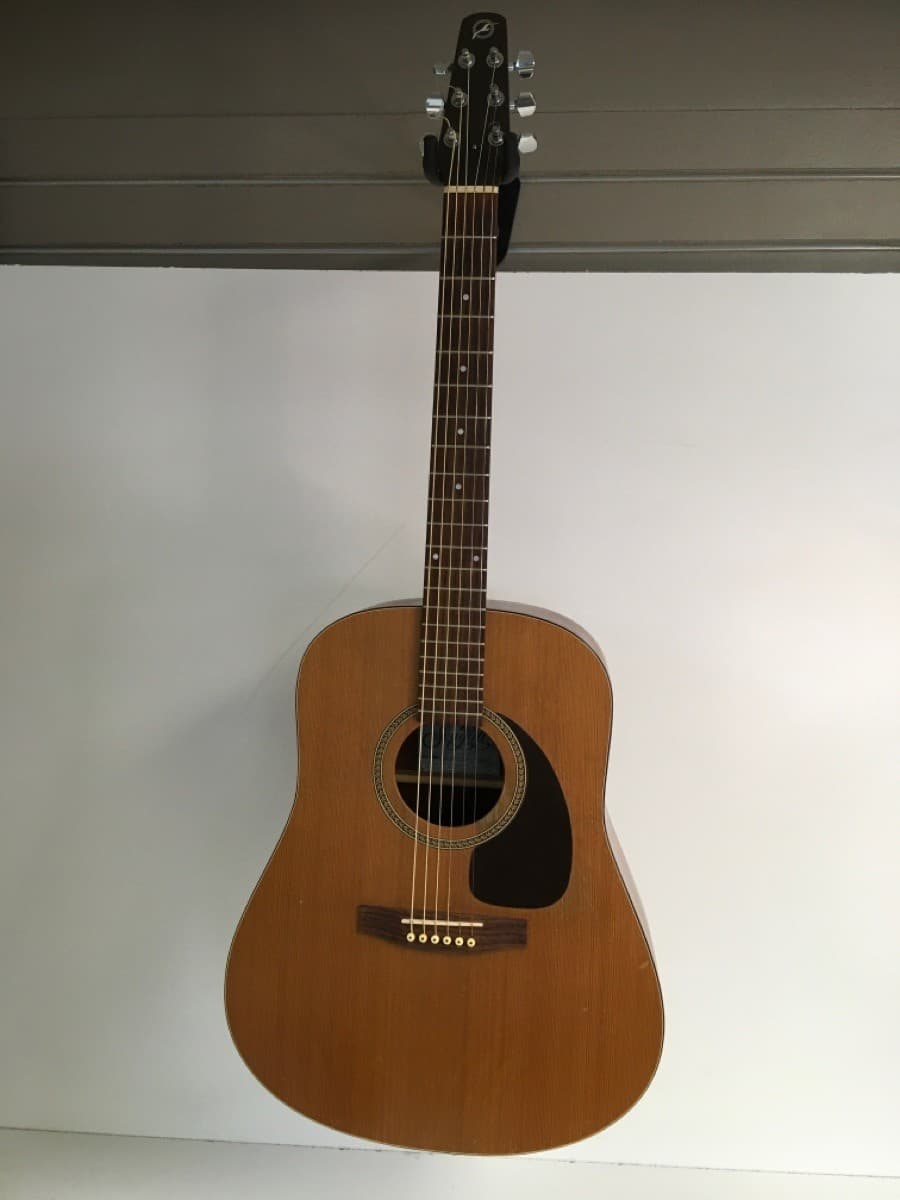
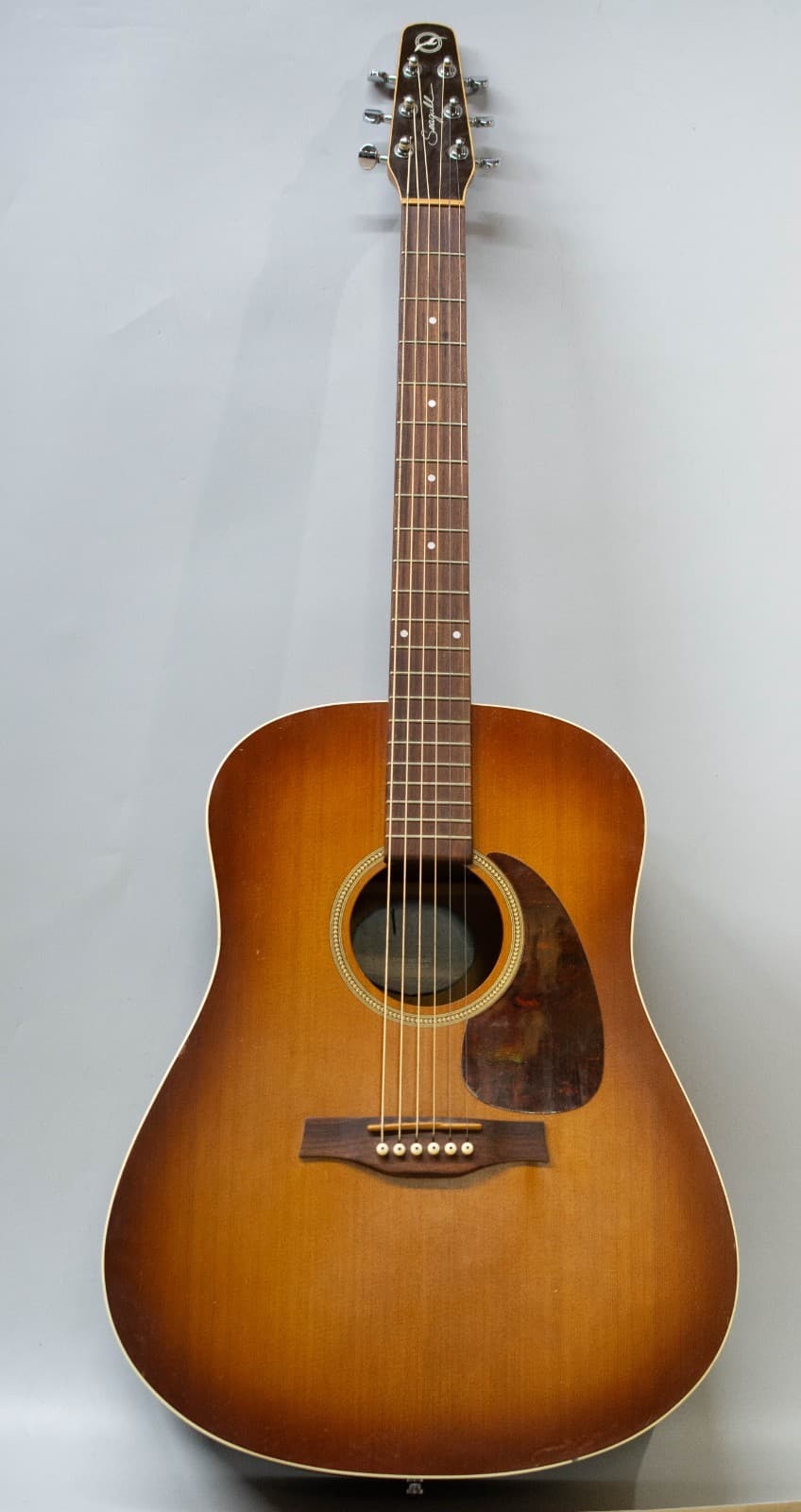
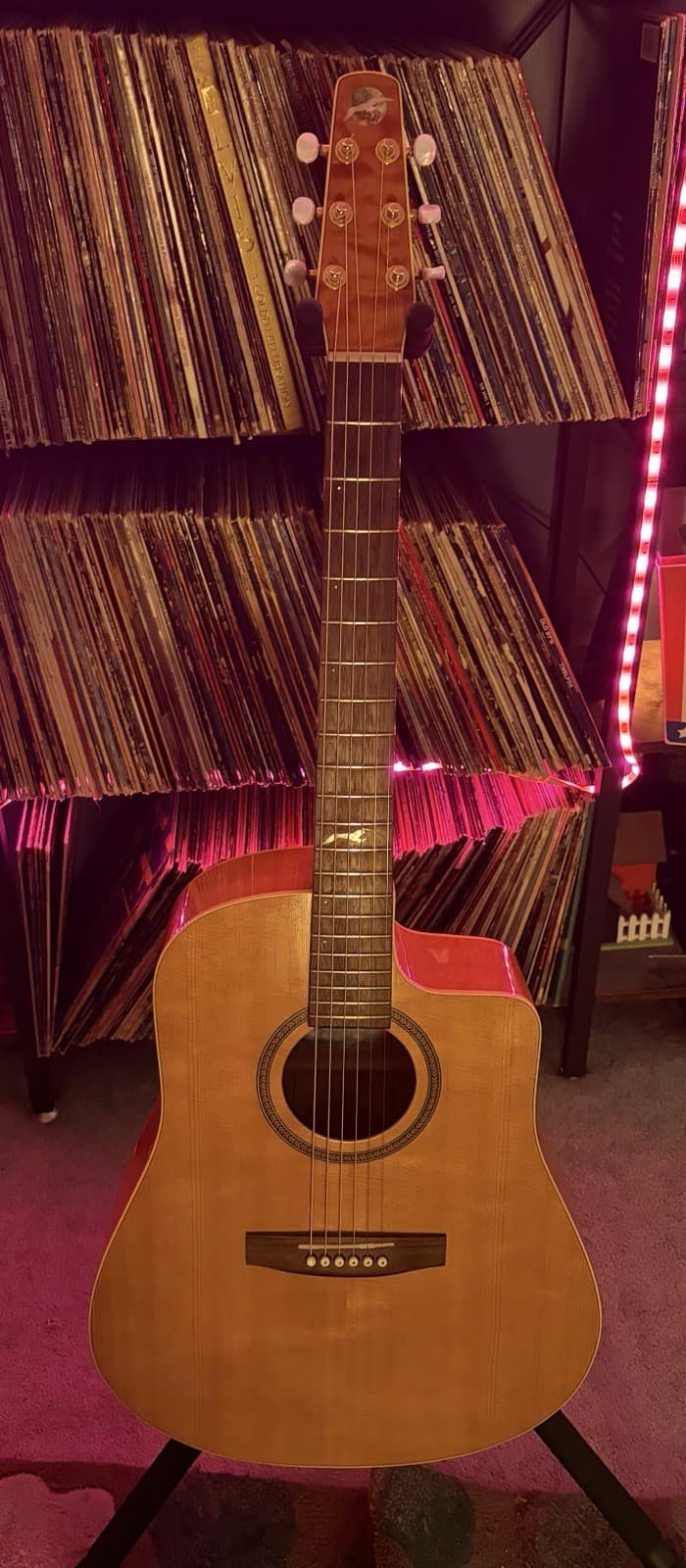
Seagull S6 Original
Dreadnought acoustic · Solid cedar top, wild cherry back/sides, silver leaf maple neck, made in Canada, 25.5" scale$200–$280 usedBest for: Budget folk, finger-picking, singer-songwriters, warm cedar tone, Canadian quality
The Seagull S6 is one of the best values in all of acoustic guitar — a Canadian-made instrument with a solid cedar top at a price that competes with laminate-top imports. Cedar responds faster and warmer than spruce, making it particularly suited to folk guitar's fingerpicking traditions. The S6 has been the go-to recommendation for budget folk players for decades. At $200–$280 used, nothing in this price range competes with it on quality. Dylan, Baez, and Joni Mitchell were all cedar-top players.
What to check used: Cedar tops dent more easily than spruce — inspect used S6s carefully for top damage around the soundhole and lower bout. The wider nut (1-13/16") suits players with larger hands but may feel wide to smaller-handed players. The wild cherry back and sides are a distinctive tonal wood that some players love and others find too 'live' — play one before committing.
#2
Yamaha FG830
Dreadnought acoustic · Solid spruce top, solid rosewood back/sides, scalloped bracing, 25.6" scale$220–$290 usedBest for: Balanced folk tone, solid rosewood back/sides for this price, traditional dreadnought character
The Yamaha FG830 is the step above the FG800 with a significant upgrade: solid rosewood back and sides (not just solid spruce top). Rosewood produces a richer, more complex tone than nato with better sustain. For folk guitar where both fingerpicking and strumming are common, the FG830's spruce-over-rosewood combination is the classic tonal pairing of professional acoustic guitars. Used at $220–$290, the FG830 is consistently undervalued in the used market relative to its quality.
What to check used: Rosewood back and sides on a dreadnought produce significant low-end — for intimate finger-picking in small rooms, this can be overwhelming through amplification. For singer-songwriters playing live with a pickup, consider a smaller body instrument or an OOO/000 body size. The FG830 is better suited to players who occasionally strum as well as fingerpick.
#3
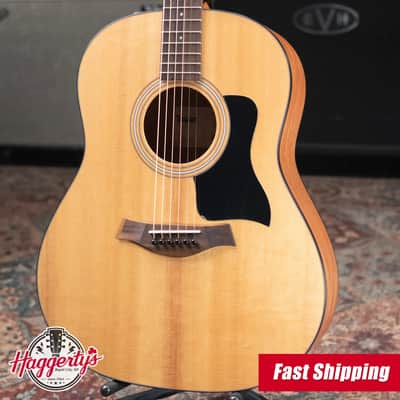
Taylor 110e
Dreadnought acoustic-electric · Solid spruce top, layered walnut back/sides, Taylor ES-B pickup, 25.5" scale$340–$450 usedBest for: Gigging folk singer-songwriters, Taylor playability, built-in electronics, modern folk sound
The Taylor 110e is the entry-level model with Taylor's NT (New Technology) neck joint and built-in ES-B electronics for direct-to-PA performance. Taylor's low, precise action setup is immediately noticeable compared to other guitars at this price — the playability is consistently excellent. The built-in electronics are essential for folk singer-songwriters who perform live. At $340–$450 used, the 110e gives Taylor quality and stage-readiness at a reasonable price.
What to check used: The layered (laminate) walnut back and sides limit the tonal depth compared to Taylor's solid-wood mid-range models. If the guitar is mainly for home practice and occasional open mics (no need for built-in electronics), the Seagull S6 or Guild D-20 may offer more acoustic character per dollar. Battery life on the ES-B preamp is 40 hours — carry a spare 9V battery.
#4
Martin 000-15M
000 size acoustic (all mahogany) · All-solid mahogany top/back/sides, 000 body size, satin finish, 24.9" scale$500–$650 usedBest for: Finger-picking focused folk, intimate performance, all-mahogany warmth, Martin quality
The Martin 000-15M is an all-solid mahogany acoustic in a 000 (triple-0) body — smaller than a dreadnought, with a focused, warm midrange that's particularly suited to fingerstyle folk music. The all-mahogany construction produces a more harmonically complex, slightly compressed tone compared to spruce tops, with excellent note separation for finger-picked lines. The satin finish gives it a natural acoustic feel. Martin's construction quality is world-class. Used at $500–$650.
What to check used: The 000 body has less volume projection than a dreadnought — for strumming folk that needs to project in a room without amplification, you may want a D-size (dreadnought) Martin instead. Verify the serial number is authentic (Martin serial numbers are well-documented online). Check the finish for checking (small cracks) near the binding — a common issue on solid mahogany under certain humidity conditions.
#5
Guild D-20
Dreadnought acoustic · All-solid mahogany body, satin finish, Guild bone nut and saddle, 25.625" scale$380–$480 usedBest for: Folk, bluegrass, singer-songwriters, all-mahogany warmth, Guild heritage
Guild has been making acoustic guitars for folk and bluegrass since 1952 — their instruments have appeared on recordings by Joan Baez, Bob Dylan, and countless others. The D-20 is the entry-level all-solid mahogany Guild dreadnought, with a bone nut and saddle (a quality upgrade over plastic at this price) and Guild's classic dreadnought voice: authoritative, warm, and projecting. Used at $380–$480, it's a genuine American-heritage acoustic guitar at a reasonable used price.
What to check used: Guild's current production moved from the US to China in recent years — verify whether a used D-20 is an older Chinese-production Westerly or a newer Dalian factory build. Both are good instruments, but some buyers prefer the older production. Current Guild models are consistently well-reviewed regardless of factory.
#6
Gibson J-45 Standard
Slope-shouldered dreadnought acoustic · Solid Sitka spruce top, solid mahogany back/sides, LR Baggs pickup, 24.75" scale$1,400–$2,000 usedBest for: The quintessential folk/singer-songwriter guitar, Gibson slope-shoulder voice, recording standard
The Gibson J-45 is arguably the most important acoustic guitar in folk music history — it is the guitar associated with Bob Dylan, Johnny Cash, Pete Seeger, and hundreds of other folk legends. The slope-shouldered body design produces a more focused, midrange-forward tone than a square-shouldered dreadnought, which makes vocals cut through clearly when strummed. The LR Baggs pickup is high-quality for live performance. Used at $1,400–$2,000, the J-45 is a professional investment in one of music's most iconic instruments.
What to check used: Gibson acoustic guitars require careful inspection: check the top for back-bowing (bellying behind the bridge), neck joint integrity, and verify the internal ladder bracing is all secured. Gibson acoustics can develop neck angle issues that require professional reset (an expensive repair). Verify the neck angle is correct — the bridge saddle should not appear unusually high to compensate for a falling neck.
#7
Collings D1
Dreadnought acoustic · Adirondack spruce top, mahogany back/sides, hide glue construction, bone nut/saddle, 25.625" scale$2,000–$2,800 usedBest for: The best acoustic dreadnought available under $3,000 used, recording, investment-grade folk guitar
Collings Guitars builds what many consider the finest acoustic guitars in current production — the D1 is the standard dreadnought with Adirondack spruce top, mahogany back and sides, hide glue construction (traditional and acoustically superior), and bone nut and saddle as standard equipment. The Collings D1 competes with pre-war Martins and vintage Gibsons on tonal quality. Used at $2,000–$2,800, a Collings holds value well and represents a genuine lifetime guitar for a serious folk player.
What to check used: At this price point, authenticate carefully and inspect thoroughly. Collings serials are documented and verifiable. The Adirondack spruce top is a premium material that requires proper humidity management (45-55% relative humidity). Any cracking or structural issues require professional luthier assessment before purchase.
#8
Martin D-28
Dreadnought acoustic · Solid Sitka spruce top, solid Indian rosewood back/sides, standard X-bracing, 25.4" scale$1,100–$1,600 usedBest for: The definitive folk and bluegrass dreadnought, rosewood projection, Martin heritage
The Martin D-28 is the most iconic acoustic guitar in American folk and bluegrass music. Its Sitka spruce top over Indian rosewood back and sides produces the authoritative, projecting sound heard on folk recordings since the 1930s. Woodie Guthrie, Hank Williams, and Doc Watson all played D-28s. This guitar is the acoustic guitar against which every other dreadnought is measured. Used at $1,100–$1,600 for modern production models, with pre-1970s vintage models commanding $3,000–$10,000+.
What to check used: Martin acoustic guitars require humidity management — solid rosewood and spruce crack in very dry conditions below 45% relative humidity. Used D-28s can develop checking (fine finish cracks) or top cracks if stored in dry environments. Inspect the top carefully, especially near the X-brace location and along the grain. Verify the serial number and confirm it's a genuine US-production Martin, not an alternative import.