#1
Boss Katana-50 MkII
Solid-state modeling amp (50W) · 50 watts (switchable 0.5/25/50W), 5 amp characters, Boss effects section, Tone Studio software, 12-inch speaker$250–$300 new / $170–$220 usedBest for: Best overall amp under $300, power switch for home and gig use, Boss effects quality, modeling versatility
The Boss Katana-50 MkII is the most recommended guitar amp under $300 — the power-level switch (0.5W/25W/50W) provides true versatility from bedroom practice at whisper volume to small venue performance at full power. Boss Tone Studio software offers hundreds of additional amp models and effects. Five built-in amp characters (Clean, Crunch, Lead, Brown, Acoustic) cover most playing styles. At $170–$220 used, it represents exceptional value for features and quality. The industry consensus for the best budget amp.
What to check used: The Katana is a solid-state modeling amp — it produces a different physical feel than tube amplifiers under the fingers. Players who specifically want tube amp compression and dynamics will not find that character in the Katana. The Katana is excellent at what it does (versatile, quiet at low settings, professional at 50W) but is not a tube amp substitute.
#2
Fender Champion 40
Solid-state modeling amp (40W) · 40 watts, 12-inch speaker, 16 amp voices, 17 effects, aux in, headphone out, Fender tone style$220–$260 new / $150–$200 usedBest for: Fender amp voices at budget price, 40 watts for small gigs, 16 amp models variety, Fender brand reliability
The Fender Champion 40 is the Fender brand answer to the Katana — 40 watts with 16 amp voices and 17 effects at $150–$200 used. Fender's modeling captures the Fender amp characters (Twin, Deluxe, Bassbreaker) accurately alongside British and high-gain models. The 12-inch speaker provides full-range frequency response. For players who want Fender brand quality and Fender-voiced amp models at a budget price, the Champion 40 is the practical choice.
What to check used: The Champion 40's modeling is somewhat less comprehensive than the Katana-50's Tone Studio software ecosystem — the Katana offers more model expansion through software. The Champion 40 is a self-contained product with its built-in voices; the Katana is more expandable. For players who want the maximum tonal versatility through software updates, the Katana is the better platform.
#3
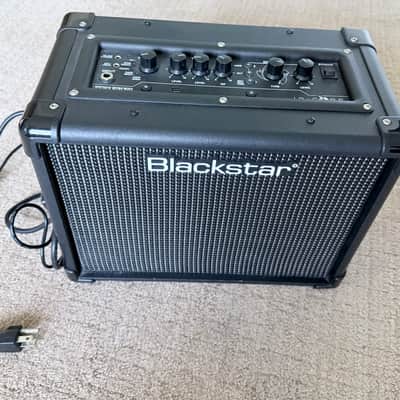
Blackstar ID:Core 40 V3
Stereo solid-state modeling amp (40W stereo) · 40 watts stereo (2x20W), two 5-inch speakers, 6 voicings, Super Wide Stereo, USB audio interface built-in$250–$300 new / $160–$220 usedBest for: Stereo stereo stereo effects experience, USB audio interface included, Blackstar voicings, home recording capability
The Blackstar ID:Core 40 V3 is unique — a stereo amplifier (two 20W channels, two 5-inch speakers) that produces a wide stereo field from modulation and reverb effects that sounds unlike any mono amp. The Super Wide Stereo is genuinely impressive for home playing and recording. The built-in USB audio interface allows direct recording to a computer without additional hardware. For players who play at home and want to record, the ID:Core 40 combines amp and interface in one unit. Used at $160–$220.
What to check used: Two 5-inch speakers versus one 12-inch speaker produces a different sound character — the stereo width and imaging of the ID:Core 40 is its strength, but it lacks the low-end punch and air movement of a 12-inch speaker. For live performance where projection is critical, a 12-inch speaker amp (Katana-50, Champion 40) projects better. The ID:Core 40 is optimized for home use and recording.
#4
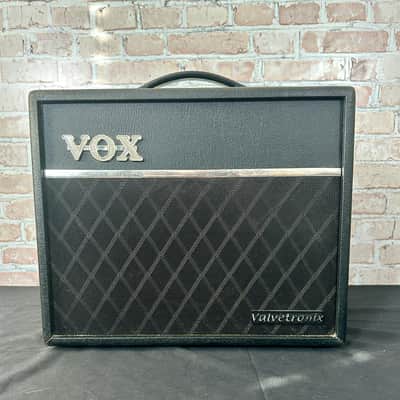
Vox VT40X
Valve Reactor modeling amp with preamp tube (40W) · 40 watts, 12-inch speaker, 11 amp models, 13 effects, one 12AX7 preamp tube, Valve Reactor circuit$280–$320 new / $190–$250 usedBest for: Hybrid tube/modeling amp, 12AX7 preamp tube for tube character, Vox amp models, 12-inch speaker projection
The Vox VT40X includes a 12AX7 preamp tube in the signal path — this is a hybrid (tube preamp, solid-state power amp) design that adds a degree of tube warmth and dynamics to the modeling. The 12AX7 does not make it a full tube amp, but the tube preamp contribution is noticeable compared to fully solid-state modeling amps. Vox's own amp models (AC15, AC30) are particularly well-represented. For players who want closer-to-tube character in a budget amp, the Vox VT40X is the choice. Used at $190–$250.
What to check used: The 12AX7 preamp tube in the VT40X requires occasional replacement (every few years of regular use) — factor in occasional tube replacement cost ($8-15 per tube). The tube contribution is in the preamp stage; the power amplifier is solid-state. Players expecting a full tube amp experience will find the VT40X is still primarily a modeling amp with a tube preamp warmth contribution.
#5
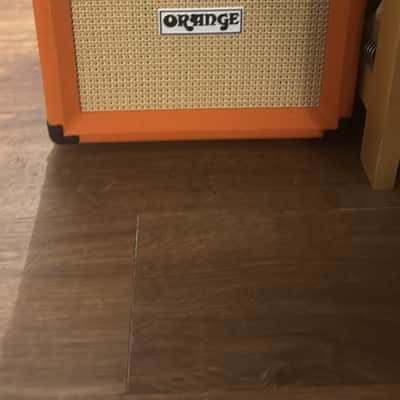
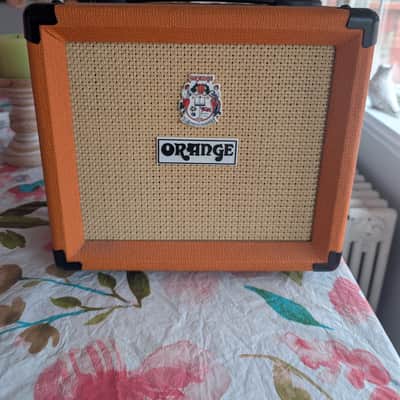
Orange Crush 35RT
Solid-state amp with reverb and tuner (35W) · 35 watts, 10-inch speaker, built-in reverb, built-in chromatic tuner, Orange voiced preamp, headphone out$230–$280 new / $160–$200 usedBest for: Orange tone and aesthetic at budget price, built-in tuner for convenience, warm punchy Orange character
The Orange Crush 35RT provides Orange's warm, punchy amp character at a budget price — Orange amps have a distinctive organic, compressed sound that many players love. The 35RT includes a built-in chromatic tuner (rare at this price) and reverb. For players who specifically want Orange tone character and aesthetics without the price of tube Orange amps, the Crush 35RT is the accessible path. Used at $160–$200.
What to check used: The Orange Crush 35RT's 10-inch speaker produces less low-end and projection than 12-inch speaker alternatives. For small gig use, the 10-inch speaker limits the amp's ability to fill a room. The Crush 35RT is excellent for home practice and small rehearsal rooms but may be insufficient for even small live venues without a PA system.
#6
Peavey 6505 Mini Head
Mini tube amp head (20W) · 20 watts, EL84 power tubes, 12AX7 preamp tubes, two channels (clean/lead), effects loop, 20W/5W switch$250–$300 new / $180–$240 usedBest for: Metal and hard rock players wanting real tube tone under $300, 6505 preamp character, transportable mini head
The Peavey 6505 Mini Head is the most affordable way to get genuine 6505 tube amp character — the 6505 circuit is the definitive high-gain amp voice used by metal and hard rock bands for decades. The mini head runs 20 watts (switchable to 5 watts) with EL84 power tubes. This is a real tube amplifier, not modeling. For metal players who specifically want the 6505 high-gain tube tone at budget pricing, the Mini Head is the path. Used at $180–$240 (requires a separate speaker cabinet).
What to check used: The Peavey 6505 Mini Head requires a separate speaker cabinet — it is a head only, not a combo amplifier. Budget for a cabinet ($100-200 minimum) in addition to the head price. Also, the 6505 Mini Head is specifically voiced for high-gain metal tones; it is not a clean amp. Players who want both clean and dirty tones with equal quality should choose the Katana-50 or Vox VT40X.
#7
Marshall DSL20CR
Tube combo amp (20W, 2 channels) · 20 watts, EL84 power tubes, 2 channels (Classic Gain/Ultra Gain), 12-inch speaker, digital reverb$650–$700 new / $400–$500 usedBest for: Marshall tube tone with two gain channels, real EL84 tubes, Marshall's entry all-tube combo, classic rock and hard rock
The Marshall DSL20CR is at the top of this guide's budget range (used at $400–$500) but provides something none of the under-$300 options do: a fully functional all-tube Marshall with two channels. The Classic Gain channel covers clean to mild overdrive; the Ultra Gain channel covers hard rock and metal territory. EL84 power tubes provide real tube dynamics. For players committed to real tube tone and who can stretch the budget to $400–$500 used, the DSL20CR is the recommendation.
What to check used: The Marshall DSL20CR exceeds the $300 guideline at current used prices — it is included because the quality jump from a $200 modeling amp to a $400 tube Marshall is significant. At $400-500 used, the DSL20CR competes with the Fender Blues Junior and Vox AC10C1, not with the budget modeling amps. Evaluate against those options if the budget can stretch.
#8
Fender Frontman 65R
Budget solid-state amp (65W) · 65 watts, 12-inch speaker, reverb, 2 channels (clean/drive), effects loop, Fender solid-state voicing$250–$290 new / $140–$190 usedBest for: High-wattage practice amp with reverb, Fender brand solid-state, effects loop for pedal use
The Fender Frontman 65R is the high-wattage budget option — 65 watts with a 12-inch speaker produces louder clean and distorted tones than most sub-$300 amps. The effects loop allows inserting pedals cleanly before the power stage. For players who want maximum volume headroom in a budget amp, the Frontman 65R provides more clean volume than the Katana-50 MkII at equivalent output settings. Used at $140–$190.
What to check used: The Frontman 65R's built-in distortion channel is not competitive with the modeling amps in this guide — it is a simple transistor distortion circuit rather than a modeled amp character. For players who use external distortion and overdrive pedals (which sound best through a clean amp), the Frontman 65R's clean channel is useful. Players who rely on amp gain for their distortion tone will prefer the Katana or Blackstar ID:Core.