#1
Fender Stratocaster
Best overall · Funk, soul, R&B, disco-funk$500–$1,000 usedBest for: Nile Rodgers (Chic, Daft Punk), Tom Morello, Prince (early)
The Stratocaster is the definitive funk guitar. Nile Rodgers' "Le Freak," "Good Times," and the entire Chic catalog were made with a Strat. The in-between pickup positions (2 and 4) produce the characteristic "quack" that sits perfectly in a funk arrangement — bright enough to cut through horns and keys, with enough sparkle to accent the 16th-note rhythmic patterns. Nile Rodgers calls his Hitmaker Strat his most important instrument.
What to check used: Single coils pick up 60-cycle hum from stage lighting and PA systems common in live funk and soul settings. Properly shielded guitars are quieter — verify the control cavity is shielded, or budget for a copper tape shielding job ($20 DIY).
#2
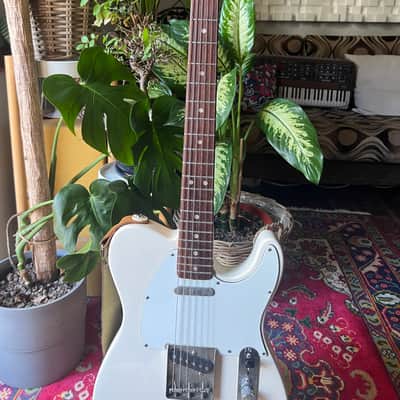
Fender Telecaster
Percussive rhythm · Soul, funk, groove-oriented rhythm guitar$400–$800 usedBest for: Percussive rhythm funk — James Brown band era, Keith Richards funk
The Telecaster's bridge pickup produces a sharper, more percussive attack than the Stratocaster — better for players who use the guitar more as a rhythm instrument and less for melodic lines. Many soul and funk rhythm guitar parts are built around the Tele bridge pickup's "cut": the attack at the front of each note is the rhythmic event. Curtis Mayfield played a Telecaster for soul and funk-adjacent recordings. The simplicity suits rhythm-focused players.
What to check used: The Telecaster's bridge pickup can sound harsh through bright amplifiers in high-treble environments. Roll back the tone control to 7–8 and find a slightly warmer amp EQ for clean funk playing.
#3
Rickenbacker 330 / 360
Best for Prince tone · Prince-style funk, R&B, art-funk$800–$1,600 usedBest for: Prince — the most identifiable funk guitar sound
Prince used Rickenbacker guitars extensively — particularly during his 1999 and Purple Rain era — to produce a uniquely bright, chiming, almost metallic funk tone. The Rickenbacker's high-output toaster pickups and chiming character are central to songs like "Let's Go Crazy" and the "Purple Rain" album. The narrow neck profile suits the flowing, melodic style Prince brought to funk. No other guitar quite captures that specific Prince-era sound.
What to check used: Rickenbackers have a uniquely narrow neck (1-5/8" nut) that some players find cramped. Try before buying if possible. The electronics — dual output jack, Hi-Gain pickups — are non-standard and require some familiarity.
#4
PRS Custom 24
Modern funk, R&B · Modern R&B, soul, funk-rock$700–$1,800 usedBest for: Modern R&B and funk-rock — versatile from humbucker warmth to split single-coil
The PRS Custom 24's coil-split is particularly useful for funk: the full humbucker provides warmth for slower, chord-based R&B; the split single-coil provides the brightness and attack for funk rhythm patterns. Modern R&B and funk-rock guitarists increasingly use PRSes for this versatility. The build consistency is exceptional — fret level, intonation, and electronics are precise from the factory.
What to check used: The PRS neck profile is distinctly different from Fender — wider at the nut and flatter in cross-section. Players used to Fender necks often need adjustment time. The coil-split switch is a push-pull on the tone pot; it's easy to accidentally engage or disengage during performance.
#5
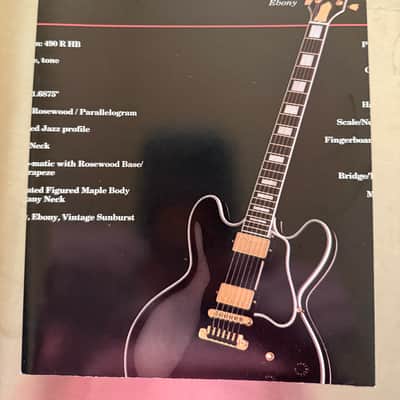
Gibson ES-335
Soul & jazz-funk · Soul, jazz-funk, blues-funk$1,200–$3,000 usedBest for: Soul and jazz-funk — BB King, Kenny Burrell, George Benson
The ES-335 suits the soulful, warm end of funk and R&B. Its semi-hollow construction adds warmth and harmonic complexity that pure solid-body guitars lack. For jazz-funk and soul-funk (think Bob James-era CTI records), the ES-335's tone is more appropriate than a bright Stratocaster. Players like Wes Montgomery and George Benson brought jazz phrasing to soul contexts on semi-hollow guitars; the warmth complements complex chord voicings.
What to check used: High-gain use with the ES-335 can cause microphonic feedback from the hollow body resonating. For funk contexts this is usually not an issue (funk is clean), but be aware if you intend to use any significant drive.
#6
Ibanez AF95
Jazz-funk · Jazz-funk, soul-jazz, vintage R&B$400–$650 usedBest for: Jazz-funk and soul — warm, full-hollow tone at a lower price than Gibson
The Ibanez AF95 is a full hollow-body guitar — warmer and more acoustically resonant than the semi-hollow ES-335. It uses Super 58 pickups (PAF-inspired humbuckers) that produce a warm, rounded tone ideal for jazz-funk, CTI-era soul-jazz, and vintage R&B. At $400–$650 used, it's a practical entry into full hollow-body tone without the Gibson archtop price ($2,000+).
What to check used: Full hollow-body guitars are susceptible to feedback at high volumes. This limits them in certain band contexts. For funk/soul sessions and smaller venues, it's manageable; for rock-volume settings, it can become problematic.
#7
Squier Classic Vibe Stratocaster
Budget · Budget funk, soul, R&B on a tight budget$200–$350 usedBest for: Stratocaster funk tone at a budget price
The Squier Classic Vibe Stratocaster is the budget path to Nile Rodgers' instrument of choice. It captures the Stratocaster's essential character — alnico single coils, five-way switching, and the in-between positions — at $200–$350 used. For a funk player starting out or on a tight budget, it delivers the correct fundamental tone. The difference between a Classic Vibe and a Fender Player Series is real but not large enough to matter in a full band context.
What to check used: Classic Vibe pickups are slightly lower-output than Fender USA pickups. In a loud ensemble (full rhythm section, horns), they may require more amp volume than a standard Strat. A pickup upgrade ($80–$150 for Fender Custom Shop pickups) resolves this.